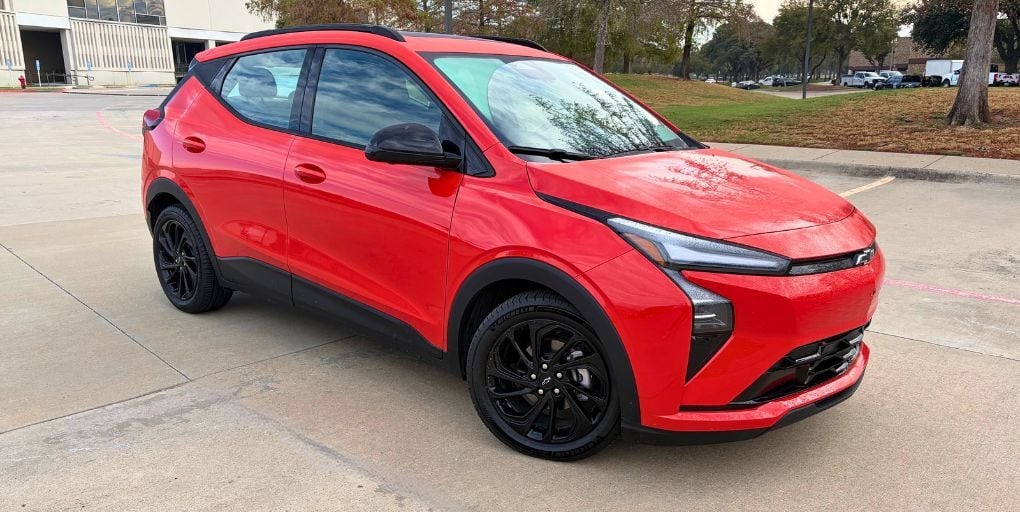

This week I am also taking a look at the 2027 Chevrolet Bolt RS, a small electric hatchback that comes back with a new look, an updated interior and a surprisingly generous helping of creature comforts. Chevrolet has given the returning Bolt an RS version for the first time, and this one arrives in Habanero Orange. Between that paint and the black trim, nobody should have trouble finding it in a parking lot. More importantly, it brings heated and ventilated front seats, a heated steering wheel and useful storage to a vehicle aimed at people who want an electric car without shopping in the luxury aisle.
EXTERIOR
The Bolt has a tall cabin, short overhangs and a sharply sloping rear hatch. Up front, narrow lighting elements flank a black strip carrying the Chevrolet bowtie, with additional lamps positioned vertically below. The black lower grille and small RS badge give the nose some attitude without pretending this is a Camaro with a charging cord.
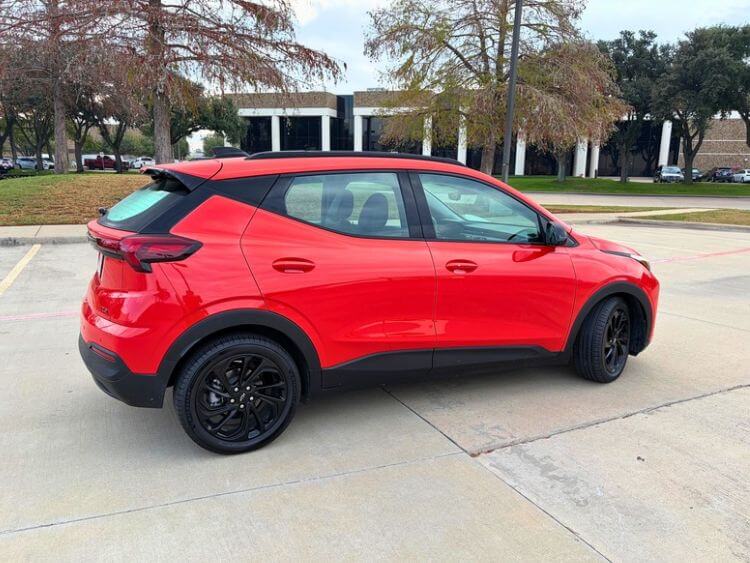
Black wheels, wheel-arch trim, lower-body cladding, outside mirrors and roof rails break up the bright paint. Around back, a roof spoiler, rear wiper, black bowtie and dark trim across the liftgate tie everything together. The charging door is on the driver’s side ahead of the front door.
PERFORMANCE
A single electric motor sends 210 horsepower and 169 pound-feet of torque to the front wheels through a single-speed drive unit. There are no conventional gear changes. The RS adds appearance and comfort equipment rather than a separate high-output powertrain. Chevrolet gives the returning Bolt a lithium iron phosphate battery and a native NACS charging port. That means access to compatible Tesla Superchargers, although you still need to check station compatibility. A dual-level charging cord is included. Battery capacity, charging rates and EPA efficiency figures are in the specifications below.
INTERIOR
The Jet Black cabin has red stitching on the seats and steering wheel, perforated seat inserts, RS embroidery on the front head restraints and contrasting light-colored dash trim. There are plenty of molded surfaces, but the different textures and red ambient-light strip keep the cabin from looking like a sea of black plastic. The optional panoramic sunroof adds light over both seating rows, with a power shade when you want less sunshine.
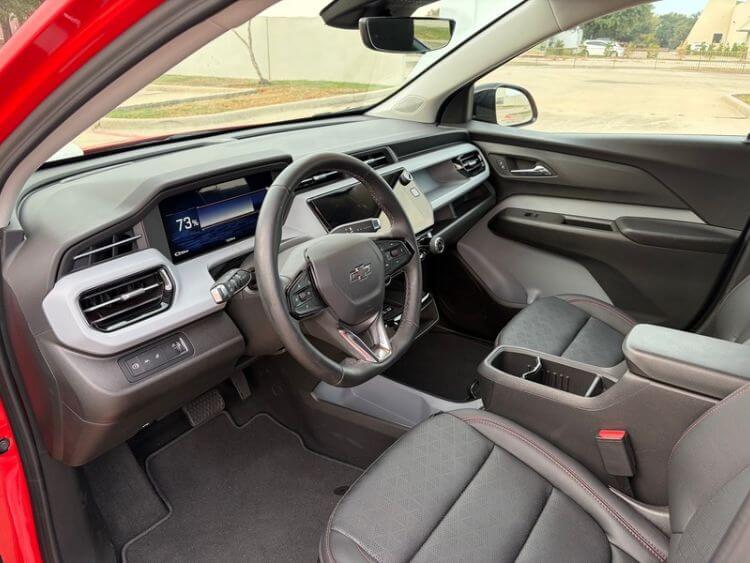
The driver gets an eight-way power seat, and both front seats are heated and ventilated. The wrapped steering wheel is heated, too. Those are welcome everyday conveniences in a small car, especially when the weather cannot decide whether it is July or January.
An 11-inch digital instrument display puts speed, battery percentage and estimated remaining range ahead of the driver. The 11.3-inch center touchscreen handles Google built-in, audio, navigation and vehicle settings. The menus include charging, camera views, drive modes, ambient lighting and vehicle status. Another screen brings up traction control, parking assistance, automatic high beams, rear automatic braking and Auto Hold.
Moving the gear selector to the steering column leaves the center area open. Beneath the climate controls is a divided charging tray, with another small shelf below it. A long, open lower bin runs toward the cupholders and padded center armrest. There is also an open passenger-side dash shelf. I like the practical approach: places for a phone, sunglasses and the other things that otherwise migrate to the passenger seat.
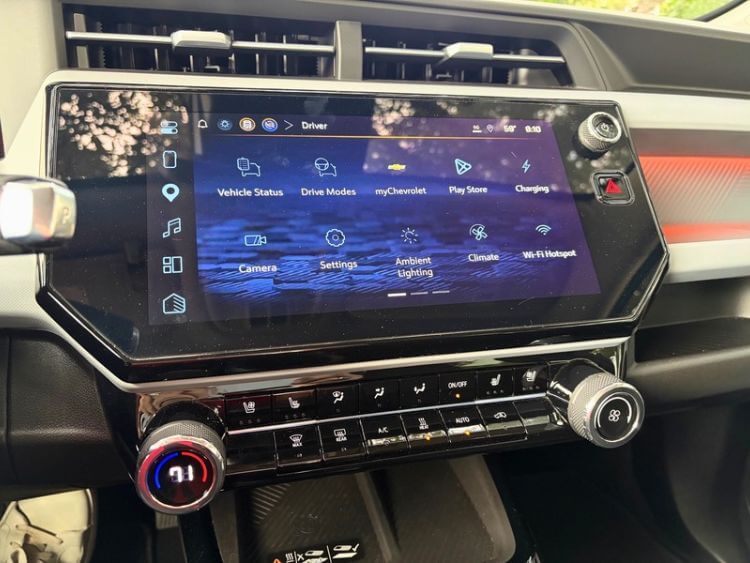
Happily, Chevrolet kept physical controls for frequently used functions. Temperature and fan-speed knobs anchor a bank of climate buttons, including seat heating and ventilation, defrosting and air-conditioning controls. A separate audio knob sits beside the touchscreen. I like being able to adjust the cabin without going on a treasure hunt through menus. Google Maps supplies navigation, while Apple CarPlay and Android Auto are absent. Phone users should try the built-in system before buying if you are used to Apple or Android connectivity.
SECOND ROW/CARGO
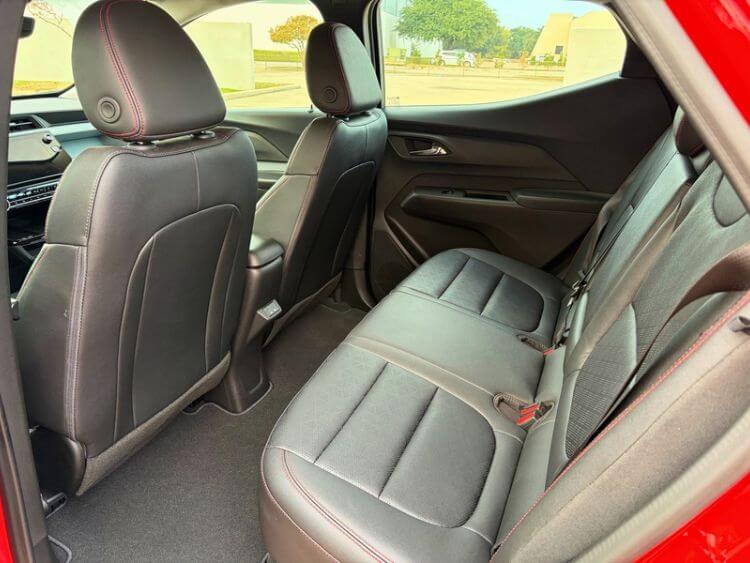
The rear bench carries the same black upholstery and red stitching as the front seats. There are three head restraints, front seatback pockets and a small charging-port panel on the back of the console. The relatively flat center floor helps the middle passenger, although the shaped outboard positions look like the better places for adults. Rear legroom is generous on paper for such a small vehicle; the real test is sitting behind your own driving position.
The hatch opens onto a carpeted load area with a broad opening, molded side panels and a recessed floor pull. The rear seatbacks split 60/40, allowing longer cargo on one side while retaining a rear passenger position on the other. Three child-seat top-tether anchors are visible on the seatbacks. The load sill sits above the cargo floor, so you will lift bags over a lip rather than slide them straight in.
STANDARD FEATURES
Standard conveniences include Evotex upholstery, front bucket seats, the power driver’s seat, heated and ventilated front seats, a heated steering wheel, single-zone automatic climate control, multicolor ambient lighting, remote start, SiriusXM capability, Google built-in, the two digital displays, 12-volt and USB-C outlets, LED exterior lighting, gloss-black roof rails, rain-sensing front wipers and a tire inflator kit. Eight years of OnStar Basics are included, subject to service terms.
OPTIONS
The dual-panel panoramic sliding power sunroof with power shade adds $1,495. The $1,195 Technology Package includes HD Surround Vision, a rear camera mirror, wireless phone charging, Rear Pedestrian Alert and Traffic Sign Recognition. The front license plate bracket adds $40. Options total $2,730.
SAFETY FEATURES
Standard driver-assistance equipment includes enhanced automatic emergency braking, Forward Collision Alert, front pedestrian and bicyclist braking, IntelliBeam automatic high beams, a Safety Alert Seat, Blind Zone Steering Assist, Rear Cross Traffic Braking, reverse automatic braking, Rear Park Assist, intersection automatic emergency braking, Side Bicyclist Alert and adaptive cruise control. The Technology Package adds the camera and alert features noted above.
RIDE AND DRIVE
The Bolt’s compact footprint and electric powertrain make daily commuting its natural assignment. Like most electric vehicles, acceleration is strong, and the interior quietness is noticeable. The ride is much better than you might expect out of a smaller vehicle, but the weight of the battery has an unintended benefit of a smooth and balanced ride.
Range planning deserves the same attention as acceleration. Highway speed, temperature and climate-control use affect how far an EV goes between charges. The range number on the instrument panel is a changing estimate, not a promise. For this car, the first ownership question is whether convenient charging fits your routine.
RANGE & CHARGING TIMES
The Bolt RS has an EPA-estimated range of 262 miles on a full charge, although speed, weather and climate-control use affect actual range. According to Chevrolet, Level 1 charging from a standard 120-volt household outlet adds approximately four miles of range per hour, so 10 hours plugged in restores about 40 miles—useful for light daily driving but charging this way could take days. Level 2 charging like I have at my house, adds approximately 27 miles per hour. For road trips, the Bolt supports Level 3 DC fast charging at up to 150 kilowatts, with Chevrolet estimating a 10%–80% charge in about 25 minutes under suitable conditions. Its native NACS port works with compatible Tesla Superchargers; charging speeds vary with the station, battery temperature and charge level.
ONE PEDAL DRIVING
One-pedal driving lets you use the accelerator to manage both acceleration and much of your slowing down. Ease off the pedal and the car decelerates; release it fully and, under normal conditions, the Bolt can come to a complete stop. Regenerative braking recovers energy as the car slows, while the system can also use the friction brakes when needed. This feature is one of the reasons I got an EV myself. When you get used to using one pedal driving, I find it extremely enjoyable.
The 2027 Bolt offers Off, Normal and High settings. Normal provides moderate deceleration when you lift, and High produces stronger slowing. Off returns you to more familiar two-pedal operation. You choose the setting through the center display’s Drive & Park controls or the Drive Modes app. According to the owner’s manual, the brake lights illuminate during substantial deceleration and when stopped.
The trick is to ease out of the accelerator instead of abruptly lifting your foot. I would start with Normal and learn its response before trying High. Keep your foot ready for the brake pedal whenever a quicker stop is needed. Chevrolet recommends switching one-pedal driving off on slippery roads. It is a convenience you can choose, not something every EV buyer has to love.
DRIVE MODES
The Drive Modes app provides access to the driving settings. Normal is for everyday use, Sport for sharper responses, Snow/Ice for gentler accelerator response on slippery surfaces and a customizable My Mode, with availability dependent on equipment. These settings are separate from the Off, Normal and High choices for one-pedal driving. Sport changes response, but it does not turn the RS into a different horsepower model.
VERDICT
At $35,725 including destination, this Bolt RS combines a manageable size with an equipment list that includes comforts once reserved for much more expensive vehicles. I particularly like the physical climate controls, open storage and heated and ventilated seats. My chief technology complaint is the absence of Apple CarPlay and Android Auto; buyers should decide whether Google built-in works for them before signing the papers.
For someone who can charge conveniently and wants a compact electric commuter, the Bolt belongs on the shopping list. As I always tell potential EV buyers, GET A HOME CHARGER. It completely changes your overall satisfaction as the owner of an electric vehicle.
The RS adds visual personality and useful comfort features, while the optional camera package makes sense for buyers who want more visibility around the car. I would choose it for how well it fits daily life, then enjoy the fact that the paint looks like it ought to come with a warning label on a hot-sauce bottle.

2027 Chevrolet Bolt RS Electric
-
What I Liked Most: Physical climate controls, useful open storage and the heated and ventilated front seats.
-
What I would change: Offer Apple CarPlay and Android Auto.
-
MSRP: Base price $31,600; options $2,730; destination $1,395; total MSRP $35,725.
-
Fuel Economy: 134 city/106 highway/120 combined MPGe; 28 kWh per 100 miles.
-
Odometer when tested: 5,200 miles.
-
Weight: 3,807 pounds base curb weight.
-
Spare tire: No spare; tire inflator kit included.
-
Length-Width-Height: 169.6 inches long/69.7 inches wide without mirrors/63.9 inches high. Width with mirrors extended is 80.1 inches.
-
Fuel Tank Capacity: N/A. Charging port on left front fender.
-
Towing Capacity: N/A.
-
Official Color: Habanero Orange; Jet Black interior with red accents.
-
2027 Chevrolet Bolt RS in a few words: A practical electric hatchback with some attitude and a generous helping of comfort at a fantastic price point.
-
Warranty: Three-year/36,000-mile bumper-to-bumper limited warranty; eight-year/100,000-mile electric vehicle propulsion battery warranty. Courtesy transportation and roadside-assistance towing coverage is five years/60,000 miles; terms and limitations apply.
-
Final Assembly Location: Kansas City, Kansas, U.S.A.
-
Manufacturer’s website: Chevrolet
Click On Photo to Enlarge
Click Arrow To Scroll