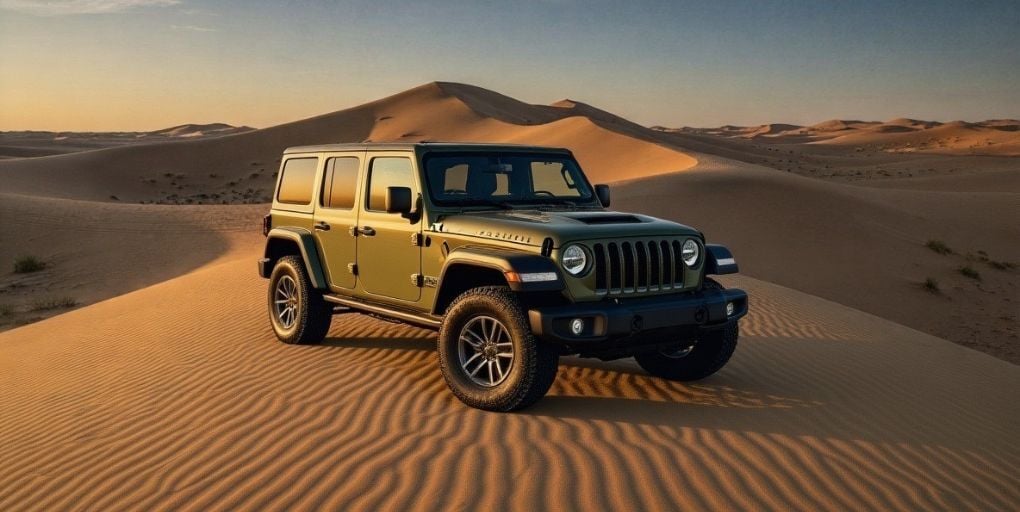

If there’s one vehicle on the road today that absolutely refuses to apologize for what it is, it’s this one. The 2026 Jeep Wrangler Moab 392 doesn’t care about fuel economy, doesn’t pretend to be civilized, and makes no effort to blend in. It’s loud, unapologetic, and wildly entertaining—basically the automotive equivalent of showing up to a black-tie dinner in cowboy boots and not caring who notices.
Exterior
Talk about a looker! The 17” machined wheels and massive 35” tires look fantastic on this Wrangler. The functional hood scoop with ‘392’ on each side sits prominently above the Jeep seven-slot grille.
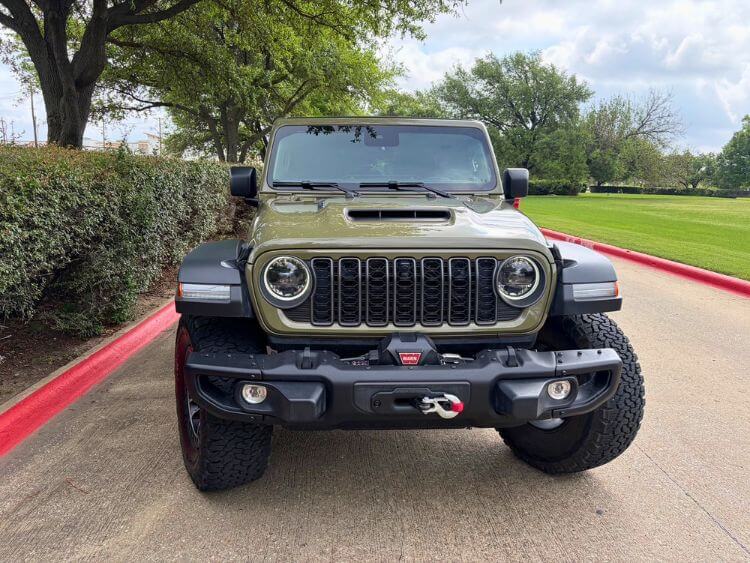
My tester has a Warn winch on the front, Moab is proudly displayed on the sides of the hood, and then there is the color, which I love. It’s called simply: ’41. ’41 is a direct reference to 1941, the year the original military Jeep went into production for World War II. That first Willys MB is essentially the grandfather of every Wrangler you see today.
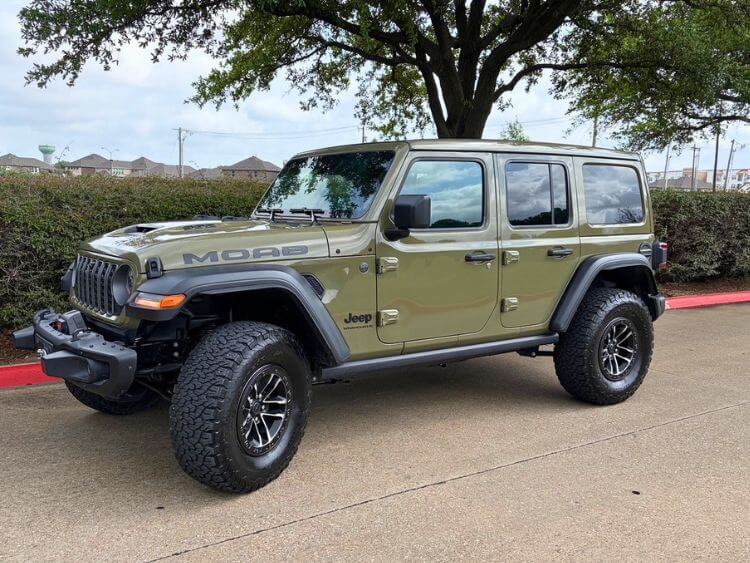
The color itself—a muted olive drab/army green—is meant to mimic the military finish used on those early Jeeps. It’s not just a random shade of green; it’s a deliberate nod to the brand’s roots as a battlefield vehicle before it ever became a lifestyle icon. Jeep has used the ’41 designation off and on over the years, usually on special trims or heritage-themed models, and it tends to resonate with buyers who like the authenticity angle. It’s one of those colors that says: this isn’t just a Wrangler—it’s a descendant. In other words, it’s Jeep’s way of saying: before mall parking lots and Starbucks runs, there was Normandy.
Performance
Under the hood is the reason this Jeep exists: a 6.4-liter V8 HEMI putting out 470-horse and 470 lb.-ft. of torque. It’s paired with an 8-speed automatic transmission, and when you hit the throttle, it doesn’t so much accelerate as it launches with authority. Jeep says 0-60 mph comes in around 4.5 seconds, which is absurd for something shaped like a brick and riding on 35-inch tires. The dual-mode exhaust gives you a choice between “somewhat loud” and “wake the neighbors,” and frankly, neither is subtle. And check this: There is NO start/stop system to annoy you!
What makes the Moab 392 special is that Jeep didn’t just drop a big engine into a Wrangler and call it a day. This thing is built to handle it. You get a full-time Selec-Trac 4WD system, heavy-duty Dana 44 front axle and Dana M220 rear axle, Tru-Lok locking differentials, and a front sway bar disconnect. The 4.56 rear axle ratio and the 35-inch tires give it serious off-road chops, while rock rails and skid plates mean you can actually use it the way Jeep intended—without worrying about tearing something off underneath. I’ll detail everything included in the Moab package a little later.
Interior
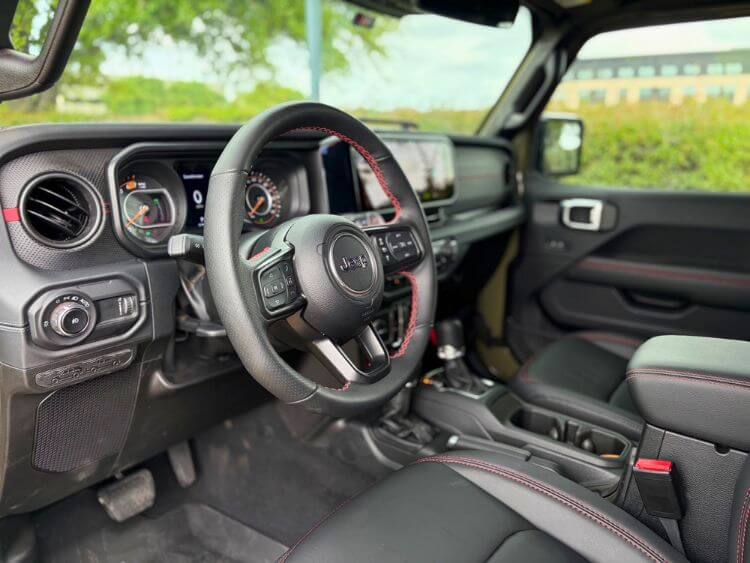
Inside, it’s a big step up from Wranglers of old. You get black Nappa leather seats, and both front seats are heated and power-adjustable with lumbar support. The centerpiece is the 12.3-inch Uconnect 5 touchscreen with navigation, Apple CarPlay, and Android Auto. It’s fast, intuitive, and one of the better systems in the segment. The Alpine premium audio system delivers solid sound, though you’ll lose some of it with the top off—which, let’s be honest, is how this Jeep is meant to be enjoyed.
Beyond entertainment and connectivity, Uconnect 5 serves as the command center for a wide range of vehicle functions. You can control dual-zone climate settings, heated seats, and fine-tune the Alpine audio system with equalizer and sound staging adjustments. It also manages Jeep Connect services like remote start, vehicle location, and health reports, while providing access to off-road pages that display real-time data such as pitch and roll, drivetrain status, and traction settings. Driver assistance features can be configured through the screen, along with vehicle settings like lighting, locks, and keyless entry behavior. You can also pair devices, manage the onboard 4G LTE Wi-Fi hotspot, and customize display preferences. It’s quick to respond and logically laid out—one of those systems you actually use instead of fight with.
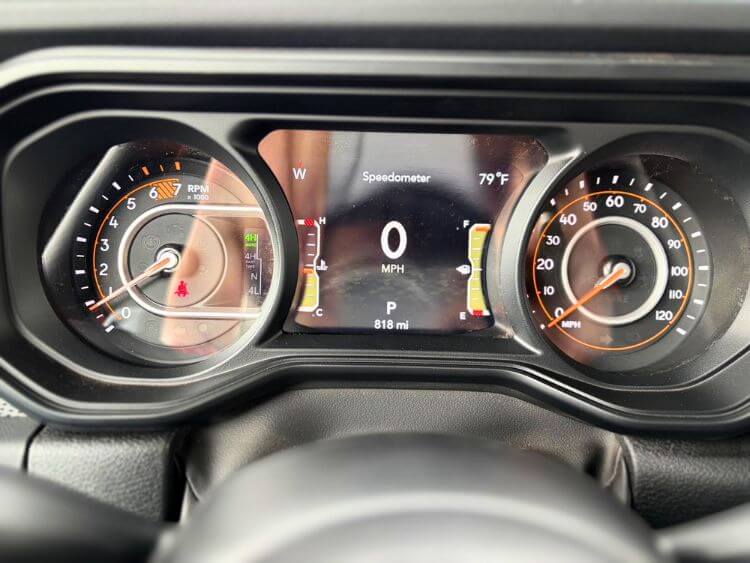
The digital driver gauge cluster is a 7-inch display that gives you real-time vehicle data and lets you cycle through multiple menus using the steering wheel controls. It shows essentials like speed, fuel range, trip info, and tire pressure, but it really earns its keep with deeper information—off-road pages with pitch and roll angles, drivetrain status, transfer case position, and locker engagement. You can also view audio info, navigation prompts, and driver assistance alerts right in front of you without taking your eyes off the road. It’s not overly flashy, but it’s functional, easy to read, and especially useful when you’re off-road and want critical information directly in your line of sight instead of buried in the center screen.
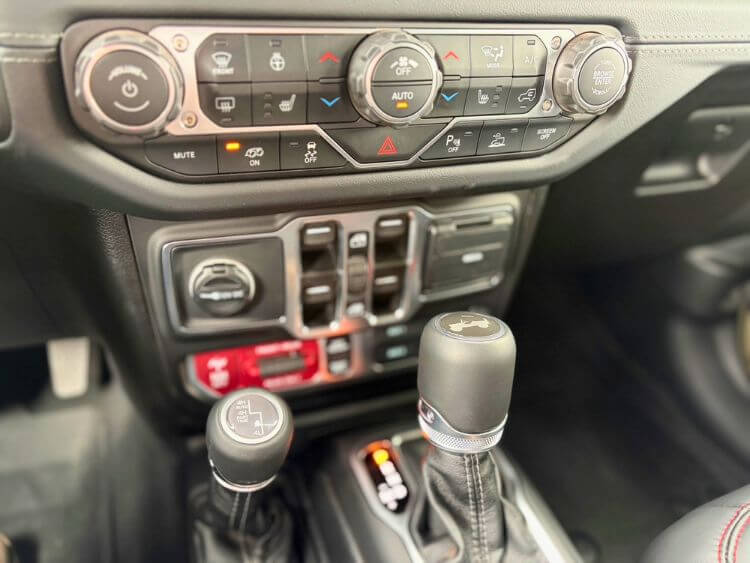
Below the center Uconnect 5 screen is a row of physical controls that make life a lot easier, especially when you’re bouncing around off-road. You’ll find large, easy-to-use knobs for volume and tuning, along with dedicated buttons for climate functions like temperature, fan speed, and airflow direction, so you don’t have to dig through menus while driving. Just beneath that are the toggle-style switches for key off-road features, including the electronic front sway bar disconnect, locking differentials, exhaust sound, and Off-Road Plus mode. You’ll also find window switches mounted in the center stack—classic Wrangler—along with media ports and a 12-volt outlet tucked below. It’s a smart mix of old-school functionality and modern tech, and in a vehicle like this, having real buttons instead of relying solely on a touchscreen is exactly what you want.
The center console is purpose-built and refreshingly straightforward, starting with the leather-wrapped gear shifter for the 8-speed automatic. Just to the right is the separate transfer case lever for engaging 4WD High and Low—old-school in the best way and far more intuitive than electronic systems when you’re off-road. Ahead of the shifters, you’ll find additional controls and drive mode selections, along with a small storage tray for phones or keys. The console itself includes dual cupholders, a padded center armrest, and a deep storage bin underneath with USB ports for charging devices. It’s not fancy, but it’s functional, durable, and exactly what you want in a Wrangler—everything is laid out logically and built to be used, not just admired.
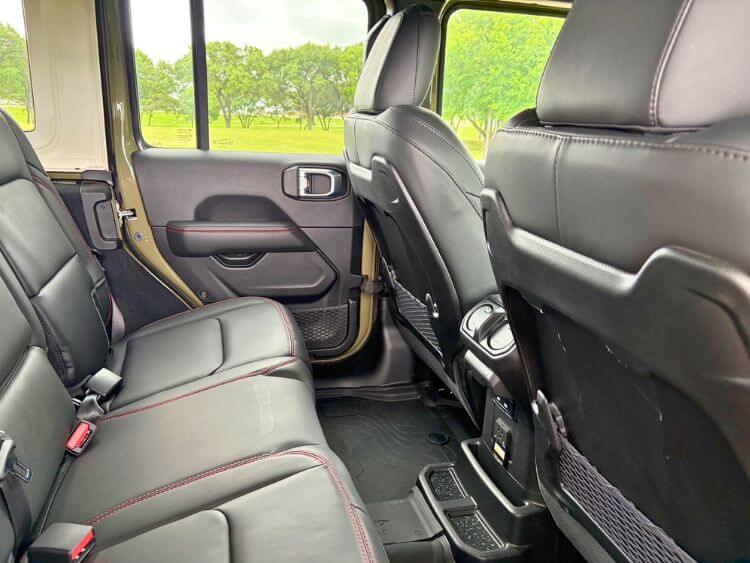
The back seat is more accommodating than Wranglers of the past, but it still reminds you this is a purpose-built SUV. Legroom is decent for adults, and the seats themselves are surprisingly comfortable, especially with the same Nappa leather upholstery carried over from the front. Rear passengers get their own air vents, a pair of USB ports for charging devices, and power window controls mounted in the center area, keeping with Wrangler tradition. There’s also a fold-down center armrest with cupholders, and the rear seats split-fold to expand cargo space when needed. Headroom is excellent thanks to the upright design, and visibility is wide open, especially with the top removed—arguably the best seat in the house when the weather is right.
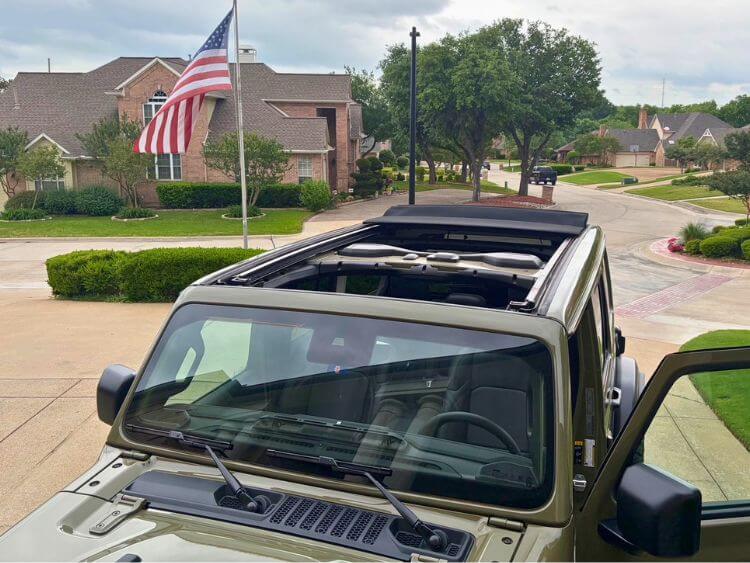
Here is the game-changer for me, the Sky One-Touch power top. It is one of the best features you can get on a Wrangler, especially if you like open-air driving but don’t want the hassle of removing panels. With the push of a button, the full-length fabric roof slides back in about 20 seconds, even at low speeds, giving you a wide-open feel without ever leaving your seat. It’s essentially a giant sunroof that runs nearly the entire length of the cabin, and you can stop it anywhere along the way depending on how much sky you want. Unlike the traditional hardtop, you still keep the rear side windows in place, so there’s less wind buffeting and it’s more practical for everyday use. The roof opens so big that it feels like you’ve taken the top off. But if you’ve ever taken the top off a Jeep, you’ll appreciate the Sky One-Touch power top even more.
The Wrangler’s roll bar setup is what Jeep calls a sport bar system, and in the four-door Moab 392 it essentially runs in two main sections that protect both rows of passengers. Up front, there’s a heavy-duty bar integrated into the windshield frame and tied into the B-pillars, which sits just behind the front seats and forms the primary structural support you see when the top is open. Behind that, a second section extends over the rear seating area, tying into the C-pillars and cargo area to protect back-seat passengers. Both sections are wrapped in padding and trim, so they don’t feel industrial, but underneath is serious steel designed to maintain the cabin’s integrity in a rollover. It’s a key part of why the Wrangler can offer removable tops and doors while still meeting safety standards—and when the roof is open, those bars are always visible, reminding you this Jeep is built for more than just pavement.
Standard Equipment
Standard features include: the 12.3-inch Uconnect 5 infotainment system with built-in navigation, Apple CarPlay, Android Auto, and SiriusXM 360L, along with an Alpine premium audio system that delivers strong sound even with the top open. You also get Jeep Connect services with a 4G LTE Wi-Fi hotspot, integrated voice command, and a customizable 7-inch driver information display in the gauge cluster. Dual-zone automatic climate control keeps things comfortable, and there’s a full-function media hub with multiple USB ports, auxiliary input, and a 115-volt household-style outlet for added convenience.
Inside, the Moab 392 comes well-equipped with black Nappa leather-trimmed seats, heated front seats, and 8-way power-adjustable front seats with lumbar support. The leather-wrapped steering wheel is also heated, and remote start adds everyday convenience. Other standard touches include keyless entry with push-button start, power windows and locks, ambient interior lighting, and a universal garage door opener.
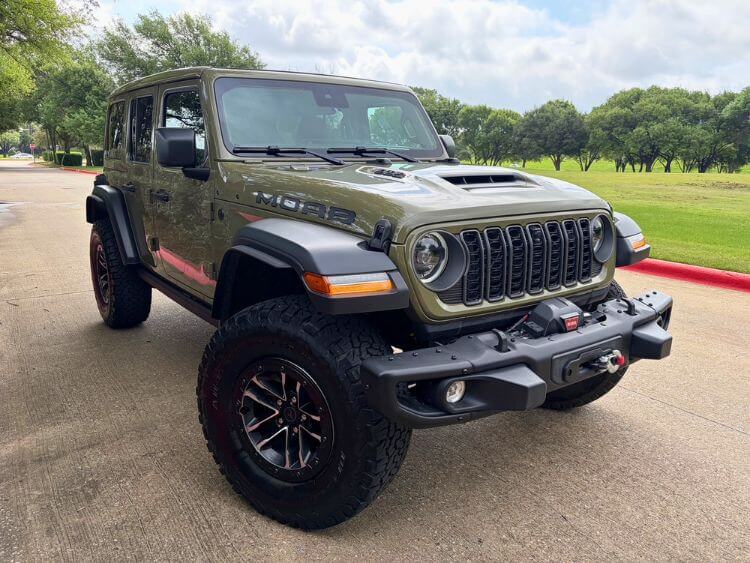
On the exterior, you get LED headlights, fog lights, and taillights, along with 17-inch wheels wrapped in 35-inch tires that give the Jeep its aggressive stance. The Sky One-Touch power top is a major highlight, offering open-air driving at the push of a button, while features like the rear window defroster, rear wiper/washer, and heated exterior mirrors make it more livable in all conditions. Add in tow hooks, skid plates, and heavy-duty bumpers, and you’ve got a Wrangler that’s as functional as it is fun.
Safety
Standard safety features abound, including blind-spot monitoring and rear cross-path detection, which are especially helpful given the Wrangler’s size and rear visibility. You also get adaptive cruise control with stop, full-speed forward collision warning with active braking, and advanced brake assist, all working together to help prevent or mitigate frontal impacts. Jeep also equips the Moab 392 with ParkSense rear park assist, a ParkView rear backup camera, and a full suite of airbags including front, side, and supplemental side curtain airbags. Electronic stability control, traction control, hill start assist, and trailer sway control are all standard, along with a tire pressure monitoring system. It’s a comprehensive list that brings modern safety tech into a vehicle that still stays true to its rugged, off-road roots.
Options
My review vehicle has $14,330 in options, including: ’41 exterior paint for $595. The big add-on is the Customer Preferred Package 27X for $10,000, which includes the Moab package itself along with Nappa leather seats, a Tru-Lok front axle, a front disconnecting stabilizer bar, a rear window defroster, and a rear window wiper/washer.
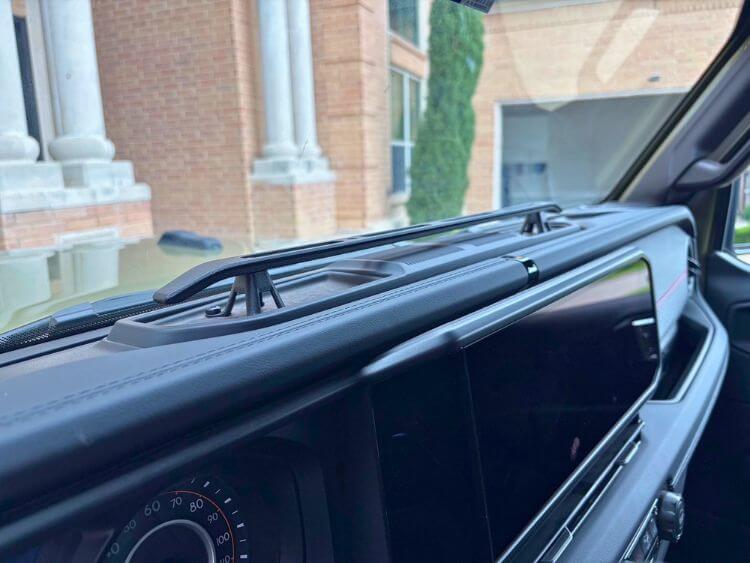
Other extras include the Multi-Function Accessory Rail by Mopar for $275, All-Weather Floor Mats by Mopar for $170, and the Sky One-Touch Power-Top for $1,295, which also includes removable rear quarter-windows and a power-top quarter-window storage bag. Rounding out the options is a Warn winch for $1,995. If you are a serious off-roader, you know the Warn Winch (not to be confused with a worn wench) is a necessity for serious off-road recovery capability, allowing you to pull yourself—or someone else—out of trouble when the terrain gets the best of you. Also, The Mopar multi-function accessory rail provides a convenient mounting point on the dash for things like phones, GPS units, or trail cameras, keeping them secure and within easy reach.
Ride and Drive
Nothing drives and performs like a Wrangler, but let’s be honest—it’s still a Wrangler. You’re sitting high, you feel the road, and it’s not something you’d confuse with a luxury SUV. But compared to older models, it’s noticeably improved. Steering is better, it tracks straighter, it isn’t as loud inside as it used to be, and it’s more livable as a daily driver than you might expect from something this extreme.
Jeep Ducking
One cool thing and a first for me: My review Wrangler came with a little Jeep duck for the dashboard. If you don’t know the story, it’s part of a fun tradition among Wrangler owners called “Jeep ducking.” It started a few years ago as a simple random act of kindness—one Jeep owner left a rubber duck on another Jeep to brighten someone’s day—and it quickly took off.
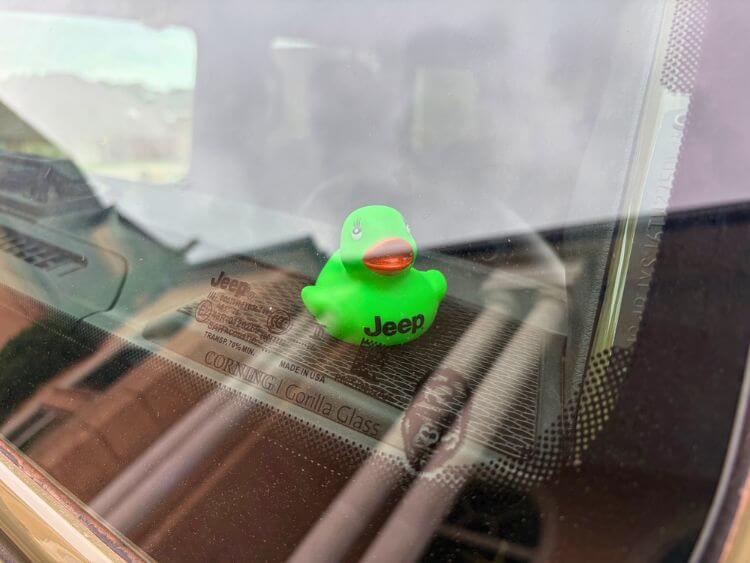
Now, Wrangler owners leave ducks on other Jeeps they admire as a way of saying “nice ride,” and many people collect them and display them across the dashboard. You’ll see some with just one or two, and others that look like a full-on duck parade riding along. It’s quirky, harmless, and honestly kind of refreshing in today’s world. Between the ducks and the Jeep wave, there’s a real sense of community here that you just don’t see with most vehicles.
MPG and MSRP
Fuel economy is exactly what you think it is: 14 MPG combined, with 13 in the city and 16 on the highway. As for pricing, the base sticker on this one is $69,995, and with options and the $1,995 destination fee, the total comes out to $86,320.
Verdict
At the end of the day, the 2026 Wrangler Moab 392 isn’t trying to be everything to everyone. It’s built for a very specific buyer—the one who wants a Wrangler turned up to eleven, with a V8 soundtrack to match. It’s impractical, inefficient, and completely over the top.
And that’s exactly why people love it, including me.

2026 Jeep Wrangler Moab 392
- What I Liked Most: The insane acceleration, exhaust sound, interior and exterior appearance, and off-road capability.
- What I would change: Nothing. Fuel economy is rough but that’s the price of admission.
- MSRP: Base Price $69,995/Total MSRP $86,320 with transportation.
- Fuel Economy: 13 city/16 highway/14 overall.
- Odometer reading when tested: 700 miles.
- Weight: 5,268 pounds/GVWR 6,400.
- Spare tire: Full-sized matching tire and wheel locked on the tailgate.
- Length-Width-Height: 188.4” long/73.9” wide/74.5” high.
- Fuel Tank Capacity: 21.5 gallons with the filler on the driver’s side.
- Towing Capacity: 3,500 pounds.
- Official Color: ‘41.
- 2026 Wrangler Moab 392 in a few words: An outstanding off-roader with insane power and acceleration, and a ton of cool features. Oh, and that exhaust! You’ll have a big smile on your face on or off the pavement.
- Warranty: 3-year/36,000-mile bumper-to-bumper, 5-year/60,000-mile power train warranty with roadside assistance.
- Final Assembly Location: Toledo, OH.
- Manufacturer's website: Jeep
Click On Photo to Enlarge
Click On Right Arrow To Scroll


.jpg?width=150&name=jerry-headshot.jpg%20(1).jpg)