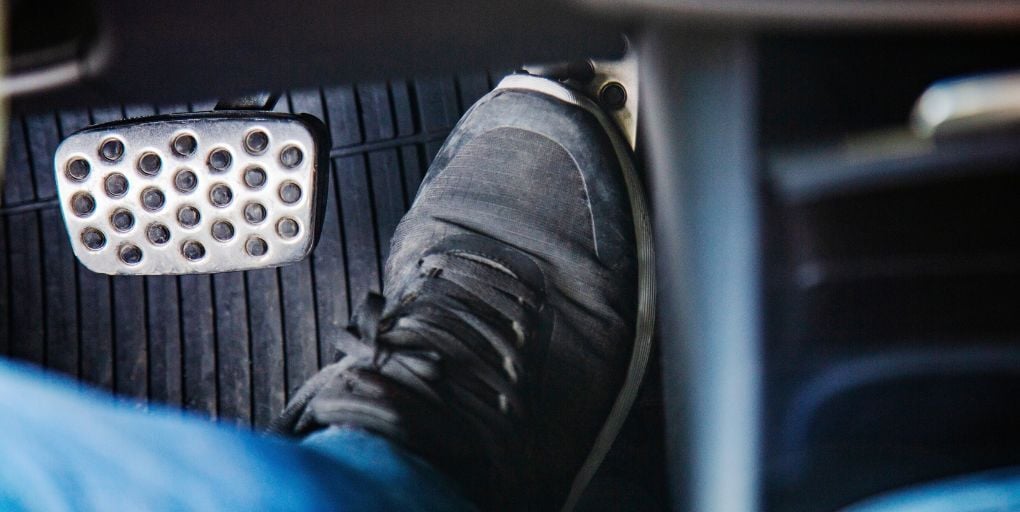

Don’t do as I do. Do as I SAY do! Advice from your Dad at some point most likely, and now, I am doing the same. Yes, I have a heavy foot. I don’t try to hide it. But I have to review cars for you, right? That gives me a pass.
Every time gasoline prices shoot up, I start hearing from people who are thinking about trading their vehicles for something that gets better fuel economy. I understand it, especially when you're driving a large SUV or pickup with a 25- or 30-gallon fuel tank. Filling up can be painful, and watching those numbers spin on the gas pump is enough to put anybody in a bad mood. But before you start shopping for a smaller vehicle, a hybrid or an electric car, I've got a suggestion that won't cost you a dime.
Take a good look at your right foot.
I've been driving and evaluating vehicles for decades, and one thing I've learned is that two people can drive the exact same vehicle over the same route and get surprisingly different fuel economy. The difference isn't necessarily the vehicle, the gasoline or the weather. A lot of times, it's the person sitting behind the steering wheel.
The U.S. Department of Energy says aggressive driving, including rapid acceleration, speeding and hard braking, can lower gas mileage by roughly 15% to 30% at highway speeds and 10% to 40% in stop-and-go traffic. Those are some pretty substantial numbers, and they help explain why one driver may complain about terrible gas mileage while another owner of the same model is perfectly happy.
Let's put that into dollars. Suppose you're driving a vehicle that normally averages 20 miles per gallon, and your driving habits reduce that to 17 MPG. At 15,000 miles per year and $4 per gallon, you'll spend approximately $530 more annually on gasoline. That's real money, and you didn't get anything extra for spending it.
One of the biggest fuel wasters is something I see every single day: people accelerating like they're trying to qualify for the Indianapolis 500, only to slam on the brakes at the next red light. I sometimes wonder whether these folks realize that every time they hit the brakes, they're throwing away energy they just paid to produce. Of course, regenerative braking in hybrids and electric vehicles can recover some of that energy, but even those vehicles benefit from smoother driving.
My advice is to look farther down the road. If you can see a red light a quarter-mile ahead, there's no reason to keep your foot buried in the accelerator until the last possible moment. Ease off the gas and let the vehicle slow naturally when it's safe to do so. You may even find the light turns green before you get there, allowing you to keep moving instead of coming to a complete stop and accelerating all over again.
Another big issue is highway speed, and this is where I may step on a few toes. I know plenty of people who wouldn't dream of driving 65 MPH when the speed limit is 75. Some routinely drive even faster. But there's a price to pay for that extra speed, and I'm not talking about speeding tickets.
The Department of Energy says fuel economy generally decreases rapidly at speeds above 50 MPH, although the exact point varies by vehicle. Its estimates suggest that each additional 5 MPH above 50 can cost the equivalent of approximately 27 cents more per gallon when gasoline is $4. That's a useful rule of thumb, not an exact calculation for every automobile, but it illustrates how expensive speed can become.
Here's why. As your speed increases, aerodynamic drag rises dramatically. Your engine has to work harder to push the vehicle through the air, and the faster you go, the more energy that requires. This is particularly noticeable in tall SUVs and full-size pickups, which have considerably more frontal area than a low-slung sedan.
You don't have to drive dangerously slowly or become a rolling roadblock. Just understand that driving 80 MPH instead of 70 MPH comes with a fuel-economy penalty. On a long road trip, that extra speed may save less time than you think, particularly after accounting for traffic, construction and fuel stops.
Cruise control can help on relatively flat highways because it maintains a consistent speed instead of allowing you to gradually accelerate without realizing it. However, in hilly terrain, maintaining an exact speed can sometimes require unnecessary acceleration and downshifting. Adaptive cruise control is wonderful technology, but it isn't automatically the most fuel-efficient way to drive under every condition. And, of course, never use cruise control when road or weather conditions make it unsafe.
Here's another habit worth examining: unnecessary idling. Modern gasoline engines generally don't need extended warm-up periods before driving. In most conditions, a brief period after starting followed by gentle driving is sufficient. Letting your vehicle idle in the driveway for 15 minutes every morning burns gasoline while you're traveling exactly zero miles per gallon.
Now, I understand the desire to cool down a vehicle on a scorching summer afternoon or warm it up on a freezing winter morning. Comfort matters, and so does visibility when you're dealing with frost or ice. I'm not suggesting you sacrifice either one. I'm simply saying that running the engine longer than necessary has a cost.
Many newer vehicles also have selectable driving modes, and if yours has an Eco mode, give it a try. Depending on the vehicle, Eco mode may soften throttle response, change transmission shift points or adjust climate-control operation to help reduce fuel consumption. It won't perform miracles, but it can encourage smoother driving, especially in city traffic.
I also want you to pay attention to how much you're asking your engine to do. Carrying unnecessary weight, leaving an empty roof rack or cargo carrier installed and driving around with equipment you rarely use can all hurt fuel economy. Roof-mounted cargo boxes are particularly troublesome at highway speeds because they increase aerodynamic drag. If you don't need it for the trip, consider removing it.
Proper tire inflation matters, too. Underinflated tires increase rolling resistance, meaning your engine must work harder to move the vehicle. Check tire pressures when the tires are cold and use the manufacturer's recommended pressures on the driver's doorjamb label, not the maximum pressure molded into the tire sidewall. Don't overinflate tires trying to squeeze out another mile per gallon.
And please don't assume expensive premium gasoline will somehow make up for poor driving habits. If your vehicle is designed to operate on regular gasoline, buying premium generally won't provide a meaningful fuel-economy advantage. If premium is required, use it. If it's recommended, consult the owner's manual to understand the manufacturer's guidance and any performance trade-offs.
One of the easiest ways to improve your habits is to start paying attention to the fuel-economy display already built into most modern vehicles. Reset your trip computer and watch what happens when you accelerate gently, maintain a steady speed and anticipate traffic. Just don't become so fascinated with the numbers that you take your attention off the road.
Make it a personal challenge. See whether you can improve your average fuel economy by 1 or 2 MPG over the next few tanks of gasoline. That's a realistic goal for some drivers, although the results will depend on the vehicle, traffic, weather and how you were driving before. Calculate your mileage over several fill-ups rather than judging one trip, since short-term readings can be misleading.
Here's something else I've noticed over the years: People who drive smoothly often arrive at their destinations feeling more relaxed. They're not constantly racing toward the next stoplight, fighting traffic or making abrupt maneuvers. They're anticipating what's happening around them, leaving adequate following distance and generally making better decisions.
That's not just good for fuel economy. It's good for safety, your brakes and your tires, too.
I realize some of you are thinking that changing your driving habits won't make much difference, particularly if you drive a thirsty pickup or SUV. But consider this: If you drive 15,000 miles annually, average 18 MPG and pay $4 per gallon, you're spending about $3,333 a year on gasoline. Improve that average to 20 MPG and your annual fuel bill drops to $3,000. That's a savings of approximately $333 without trading vehicles, financing anything or making a single payment.
And if gasoline prices go higher, the savings increase right along with them.
I'm certainly not opposed to buying a more fuel-efficient vehicle when it makes financial sense. Hybrids have become excellent choices for many drivers, and there are some terrific gasoline-powered vehicles that deliver impressive mileage. But I've also seen people spend thousands of dollars changing vehicles to save a relatively small amount at the pump, never stopping to calculate how long it would take to recover the cost of making that change.
Before you do that, try something much simpler.
Slow down a little. Accelerate smoothly. Look ahead. Avoid unnecessary idling. Keep your tires properly inflated. And pay attention to what your vehicle is telling you about fuel economy.
You might be surprised at how much gasoline you can save without spending a penny.
The next time you pull into a gas station and start complaining about the price on the pump, remember something I've learned from years behind the wheel: You can't control what the station charges for gasoline, but you have a lot more control over how quickly you burn it than you may realize.
And most of that control is sitting right under your right foot.

.jpg?width=150&name=jerry-headshot.jpg%20(1).jpg)