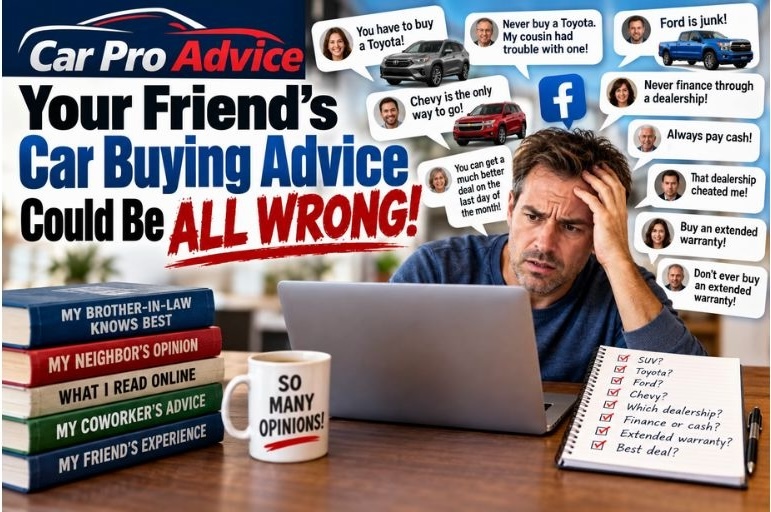

I've spent most of my adult life in the car business, and if there's one thing I've learned, it's that everybody seems to have an opinion about how to buy a car. Your brother-in-law knows the secret to getting the best deal. Your neighbor has a foolproof negotiating strategy. Your coworker knows exactly what day of the month you should visit a dealership, and there's always that one friend who claims he once bought a new vehicle for thousands less than the dealer paid for it.
I've heard just about all of it, and I can tell you from experience that some of the worst car-buying advice comes from people who are absolutely convinced they're experts.
There's something else that absolutely drives me crazy, and I see it happen on Facebook all the time. A “friend” will post a perfectly reasonable question like, "I'm thinking about buying a new SUV. What should I get?" or "Does anybody know a good dealership?" Within minutes, the responses start pouring in from people who suddenly become automotive experts. One person says Toyota is the only brand worth buying. Another says never buy a Toyota because his cousin had trouble with one 15 years ago. Somebody else insists every Ford is junk, while another swears he'll never drive anything but a Chevrolet. Then come the dealership recommendations, followed by the inevitable warnings about dealerships somebody claims cheated them years ago. By the time the poor person finishes reading all the responses, they're more confused than when they asked the question, and I don't blame them. What really gets me is that most of the people offering advice have no idea what the person actually needs, how much they want to spend, how many miles they drive or what features matter to them. They're simply recommending what they own or repeating something they've heard. I rarely chime in on those Facebook conversations, even when it's somebody I know personally. If they actually want an expert opinion from somebody who has spent a lifetime in the automobile business, they know where to find me. I'm happy to help, but I'm not interested in getting into an argument with 25 self-appointed automotive experts in somebody's comment section.
I don't think most of these folks are intentionally giving bad advice. They may have bought a car five years ago, had a good experience and decided they'd discovered the secret to beating the system. The problem is that buying a vehicle isn't a game, and the goal shouldn't be to outsmart the salesperson. The goal is to get the right vehicle at a fair price with terms you understand and can comfortably afford.
Let's start with one of my favorites: Never tell the salesperson what you can afford to pay each month.
I understand where this advice comes from. Some buyers worry that if they reveal their monthly budget, a salesperson will simply stretch the loan until the payment fits, regardless of what the vehicle actually costs. That's a legitimate concern, and I would never recommend negotiating a purchase based solely on a monthly payment.
But here's the other side of that argument. If you tell a good salesperson that you're comfortable spending $500 a month, it helps that person understand which vehicles and financing arrangements might fit your situation. There's nothing wrong with discussing your budget as long as you also know the selling price, interest rate, loan term, trade allowance and total amount financed. What I don't want you doing is agreeing to an 84-month loan on a vehicle you can't really afford simply because somebody managed to get the payment down to your magic number.
Another popular piece of advice is that you should always buy a car on the last day of the month because the dealership will practically give it away to hit its sales quota.
I wish it were that simple.
There can certainly be circumstances where a dealership is trying to reach a manufacturer sales objective or finish the month with a particular number of deliveries. I've been in that position myself, and sometimes an additional sale really does matter. But that doesn't mean every dealership is desperate on the last day of every month, or that you'll automatically get a better deal by waiting. Manufacturer incentives, inventory levels, demand for a particular model and the dealership's individual circumstances all play a role. If you find the right vehicle at a fair price on the 12th of the month, I wouldn't risk losing it just because your brother-in-law says the 31st is the only day to buy.
Then there's the old advice that you should never finance through a dealership.
That one has always made me shake my head.
Dealerships work with banks, credit unions and manufacturer-affiliated finance companies, and sometimes they can offer financing that's better than what you can arrange on your own. Manufacturer-subsidized interest rates can be especially attractive, and I've seen plenty of situations where a dealership was able to beat a customer's existing financing offer.
Does that mean you should automatically accept whatever rate the finance manager offers? Absolutely not. Get preapproved through your bank or credit union before you shop so you have something to compare. Then give the dealership an opportunity to beat it. Compare the annual percentage rate, loan term, fees and total cost, and remember that some special financing offers cannot be combined with certain rebates. You don't win anything by refusing to consider a better deal simply because it comes from the dealership.
Here's another one I hear all the time: Always pay cash because that's how you get the biggest discount.
That may sound logical, but paying cash doesn't give you more negotiating power. Years ago, it helped, but no more. Dealerships can earn compensation when they arrange financing, so a cash purchase isn't necessarily more profitable for them. (Read my advice column on cash purchases, sometimes it actually hurts you) There may also be manufacturer incentives available only when financing through a particular lender. Now, if you've got the money and don't want a car payment, I completely understand that. There's a lot to be said for owning a vehicle outright. But don't assume that announcing you're paying cash will make the dealer fall all over himself to lower the price. Compare the complete transaction before deciding how to pay.
One of the most persistent myths is that you should never tell the salesperson you have a trade-in until you've negotiated the price of the new vehicle.
I know some people believe this is the ultimate negotiating trick, but I think it often makes the process unnecessarily complicated. A dealership needs to evaluate your trade, determine its actual value and find out whether there's a loan payoff involved. Those things can affect the final transaction, particularly when negative equity is involved. In this environment, if you have a desirable trade-in, a dealer will sell a car at no profit just to have your old car on the lot.
My preference is to keep the numbers separate and understandable. Know what you're paying for the new vehicle, what you're receiving for your trade and what you're financing. Get an independent estimate or actual purchase offer for your current vehicle before you visit the dealership at CarPro.com. That way, you'll have a realistic idea of its value and can judge the offer intelligently. There's no magic in hiding your trade-in. The important thing is understanding the numbers.
Another favorite is the suggestion that you should walk into a dealership, make an outrageously low offer and threaten to leave if they don't accept it.
I've seen customers do this, and occasionally they'll get lucky if their offer happens to be reasonable under the circumstances. But walking into a dealership and offering $10,000 below a competitive market price isn't a negotiating strategy. It's usually just a good way to waste everybody's time, including your own.
Do your homework before you arrive. Research what comparable vehicles are actually selling for, understand current manufacturer incentives and make an offer based on real information. A reasonable offer backed by research will generally get you much further than a dramatic performance worthy of an Academy Award.
And while we're talking about negotiating, please don't believe the old line that every dealer has thousands of dollars in hidden profit on every new vehicle. Profit margins vary tremendously by manufacturer, model, market conditions and the individual deal. Some vehicles have substantial room between invoice and sticker price, while others have very little. Manufacturer incentives and dealer compensation programs can complicate the picture further. There isn't one universal percentage you can subtract from the window sticker and magically arrive at the right price.
Here's another piece of advice that concerns me: Never buy an extended warranty because they're all a rip-off.
I've heard that one for decades, and I strongly disagree with making such a blanket statement. A good vehicle service contract from a good dealership can provide valuable protection, particularly if you plan to keep a vehicle well beyond its factory warranty and would have difficulty handling an unexpected major repair.
But not every service contract is a good value, and not every buyer needs one. Coverage, exclusions, deductibles, claim procedures, price and the reputation of the company backing the contract all matter. You should understand exactly what you're buying, and you should never feel pressured into purchasing coverage you don't want.
The same goes for other finance-office products. Some may make sense for your situation, while others won't. The right answer depends on your needs, not your neighbor's opinion.
Perhaps the worst advice of all is that you should treat every salesperson as though he or she is trying to cheat you.
That attitude has always bothered me.
I've worked with thousands of people in dealerships over the years, and the overwhelming majority wanted to do a good job and take care of their customers. Are there dishonest people in the car business? Of course there are, just as there are in banking, real estate, home improvement and practically every other profession. But assuming dishonesty before a conversation even begins doesn't help you make a better decision.
A good salesperson can be a tremendous asset. That person can explain differences between models, identify equipment you may have overlooked, help you understand available incentives and guide you toward a vehicle that actually fits your needs. I would much rather work with a knowledgeable professional who listens to me than spend hours trying to prove I'm smarter than everybody in the dealership.
Here's what I want you to remember the next time somebody starts giving you car-buying advice, whether it's over dinner, at work or in a Facebook comment section. Ask yourself whether that person really understands today's market, financing, incentives and dealership operations, or whether they're simply repeating something they've heard for years. And when somebody recommends a particular vehicle, ask whether they know enough about your needs to make that recommendation in the first place.
There's a big difference between having an opinion and having expertise.
Buying a vehicle is one of the largest financial decisions most families make, and you deserve to approach it with good information, realistic expectations and a clear understanding of the transaction. Research the vehicle, know your budget, get financing options in advance, understand your trade's value and don't sign anything until you're comfortable with every number.
And don't forget to choose a salesperson and dealership you trust. A good relationship can be worth far more over the years than winning a negotiating argument.
As for that brother-in-law who insists he knows the secret to getting a dealer to lose money on every sale, I'd suggest thanking him for his advice and then doing your own homework.
After all, he's not the one who's going to make the payments.
You are.