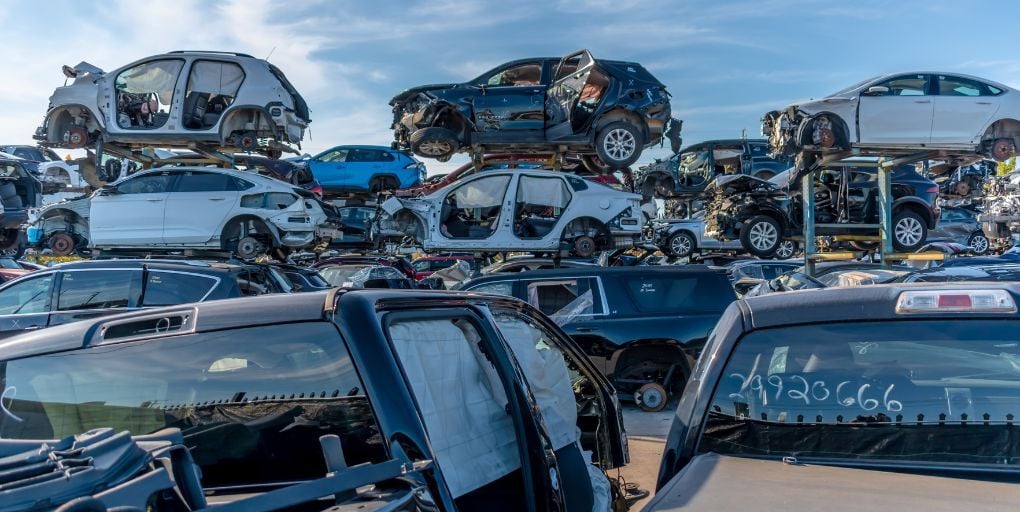

I got this caller just last week on the Car Pro Show. His car was damaged and the other insurance company totaled it. It was totally drivable and he loved the car, so he’s going to keep it even though it will have a salvage title.
Twenty years ago, that question was relatively rare.
Today, it's becoming common.
In fact, many consumers are shocked when they learn their vehicle has been declared a total loss after what appears to be a repairable accident. The airbags may not have deployed. The vehicle may still run and drive. Looking at it in the driveway, they can’t imagine why the insurance company wouldn't simply repair it.
The answer is simple.
Modern vehicles have become incredibly expensive to repair.
What many people don't realize is that insurance companies don't decide whether to total a vehicle based on how bad it looks. They decide based on economics.
At some point, the cost of repairing a vehicle exceeds a certain percentage of its value. When that happens, the insurance company determines it's more practical to pay the owner for the vehicle and sell the damaged vehicle through a salvage auction rather than spend the money to repair it. General rule of thumb is if the damage reaches 70% of the car’s value, it’s a total. It varies by insurance company but 70% is pretty common.
The problem is that the math has changed dramatically in recent years.
Take a simple front-end collision.
Years ago, replacing a bumper often meant replacing a bumper. Today, that same bumper may contain radar sensors, cameras, parking sensors, adaptive cruise control hardware, cross-traffic alert components, and pedestrian detection technology. Once the repairs are completed, many of those systems must be recalibrated to ensure they work correctly.
The bumper itself may not be the expensive part.
Everything hidden behind it often is.
The same thing has happened with windshields.
Many modern vehicles have cameras mounted near the rearview mirror that support lane-keeping assist, automatic emergency braking, traffic sign recognition, adaptive cruise control, and other advanced safety systems. Replacing a windshield often means recalibrating those systems afterward.
A windshield replacement that once cost a few hundred dollars can now cost well over a thousand dollars on some vehicles.
Headlights provide another good example.
Many LED and adaptive headlights are no longer simple plug-and-play components. Some contain motors, sensors, cameras, and sophisticated electronics. In certain luxury vehicles, replacing a single damaged headlight assembly can cost thousands of dollars.
Then there are labor costs.
Body shops today face the same challenges as every other skilled trade. Technicians are in demand, training requirements continue to grow, and repairing today's vehicles requires specialized equipment and expertise. Labor rates have increased significantly over the past several years, adding even more cost to collision repairs.
Parts costs have also climbed dramatically.
Supply chain disruptions, inflation, sophisticated electronics, and manufacturer-specific components have all contributed to higher repair bills. In many cases, replacing damaged parts costs substantially more than it did just a few years ago.
What surprises many people is that the vehicle doesn't have to be worth very little to be totaled.
Let's say you own a vehicle worth $20,000. If repairs, supplemental damage, rental car costs, and other associated expenses approach the vehicle's value, the insurance company may determine that totaling the vehicle makes more financial sense than repairing it.
Sometimes hidden damage is the deciding factor.
A vehicle arrives at a body shop with an estimate of $8,000. Once technicians begin disassembly, they discover additional structural damage, damaged sensors, wiring harnesses, suspension components, or other hidden problems. Suddenly the estimate becomes $12,000, then $15,000, and before long the insurance company decides to cut its losses.
Consumers often take this personally.
They assume the insurance company is trying to avoid repairing the vehicle.
Most of the time, that's not what's happening.
The company is simply following the numbers.
In fact, insurance companies don't particularly enjoy totaling vehicles. Total losses create paperwork, settlement negotiations, rental vehicle issues, salvage processing, and customer dissatisfaction. But when the repair costs exceed the economic value of the vehicle, the math becomes difficult to ignore.
The rapid growth of vehicle technology is accelerating this trend.
Ironically, many of the safety systems helping prevent accidents are also making vehicles more expensive to repair when accidents do occur. Automatic emergency braking, adaptive cruise control, blind-spot monitoring, surround-view cameras, lane-centering systems, and parking sensors all provide tremendous benefits. I wouldn't want to give them up.
But they come at a price.
The next time you see a vehicle with what appears to be relatively minor damage sitting in a salvage auction, remember that you're probably not seeing the entire story. Hidden damage, expensive electronics, calibration requirements, labor costs, rental expenses, and parts pricing may have pushed the repair bill far beyond what most people would expect.
Here's the bottom line.
Insurance companies aren't totaling more vehicles because cars have become weaker or less repairable.
They're totaling more vehicles because modern vehicles have become rolling computers packed with sophisticated technology, and repairing those computers after a collision often costs far more than most people realize.
What looks like a simple fender bender to you may look like a $15,000 repair bill to an insurance adjuster. And in today's world, that's often enough to turn a repairable vehicle into a total loss.

Editorial Use Only: Roseville, MI. Sept. 30, 2020.Bruce VanLoon/Shutterstock.com.
.jpg?width=150&name=jerry-headshot.jpg%20(1).jpg)