
Your car can warn you that you’re distracted, beep until you acknowledge the warning, then require you to look away from the road to figure out how to stop the beeping. Somewhere in that sequence, I think we may have lost sight of the original goal.
A new analysis released by Crowson Law Group in October examines that problem, looking at complaints submitted to the National Highway Traffic Safety Administration about distracting vehicle features. According to the law firm’s report, infotainment systems and touchscreens accounted for the largest share of the complaints it analyzed, followed by driver-attention alerts and dashboard warnings.
There is an important distinction here: This was an analysis of selected consumer complaints, not a survey measuring how often all drivers experience these problems. The percentages describe the complaints in Crowson Law Group’s analysis. They do not establish the percentage of vehicles affected or which models are the most dangerous.
Infotainment systems and touchscreens led the findings with 364 complaints, representing 47.1% of the reports analyzed. Crowson Law Group identified unintended screen inputs, sometimes called “ghost touches,” as a recurring concern. These are instances in which a system registers selections the driver did not make, creating another task for someone already occupied with driving.
Here’s a quick summary of the most distracting car features:
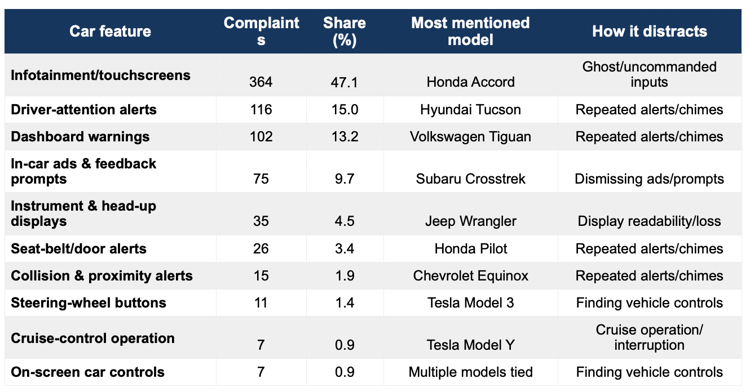
Within that category, 42.3% of complaints mentioned alerts or additional actions needed to address the problem, while 8.2% specifically mentioned taking eyes off the road. The Honda Accord was the most frequently mentioned model in the touchscreen category, according to the firm. That is a complaint count, however, rather than a rate adjusted for the number of vehicles on the road.
Driver-attention alerts finished second, with 116 complaints, or 15% of the analyzed reports. These systems are intended to recognize potential distraction or fatigue, but the complaints highlighted repeated warnings and chimes that became distractions themselves. Crowson Law Group reported that 85.5% of complaints in this category mentioned alerts or extra actions, while 18.1% mentioned looking away from the road. The Hyundai Tucson appeared most often in this group.
Dashboard warnings ranked third with 102 complaints, accounting for 13.2%. Repeated alerts and chimes were again the central issue, with 65.7% of complaints in that category mentioning alerts or additional actions. The Volkswagen Tiguan was the most frequently mentioned model.
In-car advertisements and feedback prompts placed fourth, generating 75 complaints, or 9.7%. According to Crowson Law Group, 22.7% of complaints in this category mentioned taking eyes off the road, the highest proportion among the five leading categories. Roughly nine in 10 mentioned alerts or extra input. The Subaru Crosstrek appeared most frequently in this category. Apparently, operating a moving vehicle wasn’t enough; now the dashboard would like your feedback.
Instrument panels and head-up displays ranked fifth, with 35 complaints, representing 4.5%. Readability problems and displays going blank were the main concerns identified by the firm. The Jeep Wrangler was the most frequently mentioned model in this combined category, which included both instrument displays and head-up displays.
The remaining categories were seat-belt and door alerts, with 26 complaints; collision and proximity alerts, with 15; steering-wheel buttons, with 11; and cruise-control operation and on-screen vehicle controls, with seven each.
Crowson Law Group’s findings raise a useful question about vehicle design: How much attention does a feature demand when something goes wrong? A screen that works properly is one thing. A screen making its own selections, or a warning that keeps demanding acknowledgment, presents a different challenge.
The report does not establish that these features caused crashes or that the most frequently named models have the highest defect rates. What it does document is frustration among consumers who reported that their vehicles’ interfaces competed for their attention. Technology should help drivers manage the trip. It shouldn’t keep assigning homework along the way.