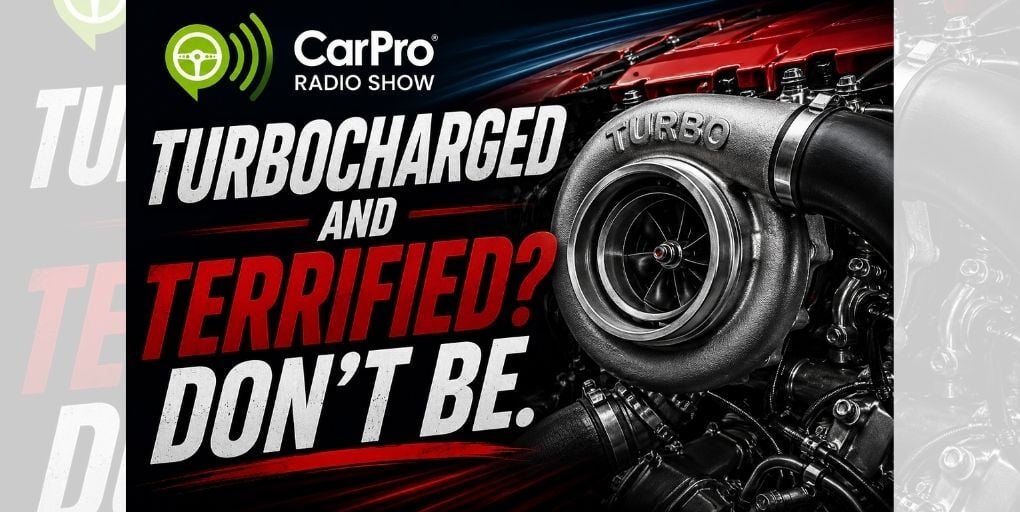

There was a time when the word “turbo” meant one thing: performance. If a car had a TURBO badge on it in the 1980s, somebody in the neighborhood was probably about to lose a stoplight race.
Today, turbochargers are everywhere. Family SUVs have them. Pickup trucks have them. Economy cars have them. In fact, many automakers have replaced larger naturally aspirated V6 and V8 engines with smaller turbocharged engines because they produce impressive horsepower and torque while also improving fuel economy. Some of the best towing vehicles have twin turbos from Ford and Toyota.
And yet, every single week I hear from people who say:
“I don’t want a turbocharged engine because I’ve heard they don’t last.”
The reality is this: modern turbocharged engines are generally very reliable. But there’s another reality too: turbocharged engines absolutely require proper maintenance. Ignore the maintenance, and eventually you may have problems.
A turbocharger is actually a pretty simple concept. Exhaust gases spin a turbine that forces additional air into the engine. More air allows the engine to burn more fuel and create more power. That’s why a turbocharged 4-cylinder today can often outperform a naturally aspirated V6 from just a few years ago.
There’s also another type of forced induction called a supercharger. Like a turbocharger, a supercharger forces more air into the engine to create additional power. The difference is how it’s powered. A turbocharger uses exhaust gases, while a supercharger is driven directly by the engine itself, usually through a belt. Superchargers typically deliver instant power with no lag, but they usually don’t improve fuel economy the way turbochargers can. The good news is that supercharged engines have also proven to be very reliable when properly maintained.
Turbochargers and superchargers are not new technology, either. They’ve been used for decades in diesel trucks, heavy equipment, aircraft, race cars, and high-performance street vehicles. What’s changed is how common turbochargers have become in everyday vehicles.
But turbochargers operate under extreme conditions. They spin incredibly fast and create enormous heat. That’s why oil becomes critically important in a turbocharged engine.
Here’s the part many people don’t understand: most turbocharger failures are not caused by the turbo itself being defective. In many cases, failures are tied to poor maintenance, skipped oil changes, dirty oil, low-quality oil filters, or sludge buildup inside the engine.
Turbochargers rely on a constant flow of clean oil for lubrication and cooling. If oil changes are neglected, tiny oil passages can clog, bearings can wear prematurely, and excessive heat can damage internal components.
In plain English: poor maintenance is the enemy of any high-performance engine component, including turbochargers and superchargers.
That doesn’t mean you should avoid turbocharged vehicles. It means you should maintain them correctly.
If your owner’s manual says change the oil every 5,000 miles, don’t decide 10,000 miles is “close enough.” If the manufacturer recommends synthetic oil, use synthetic oil. And please, don’t buy the cheapest oil filter you can find just to save a few dollars. Replacing a turbocharger costs a whole lot more than buying quality oil and filters.
Air filters matter too.
Turbochargers move massive amounts of air. If dirt or debris gets past a damaged or low-quality air filter, it can damage the turbocharger over time. Even cracked intake hoses or air leaks can eventually create problems.
Now let me calm down another common fear: turbocharged engines are not automatically “high maintenance” simply because they have turbos.
Many modern turbocharged engines routinely go well beyond 150,000 or even 200,000 miles without major problems when they are properly maintained. Ford EcoBoost engines, GM turbocharged trucks, and countless European models have proven that turbocharged engines can absolutely hold up long term.
What hurts longevity more than anything is neglect.
Another old-school habit that still has some value is letting a turbocharged engine cool down briefly after heavy use. Modern water-cooled turbochargers are much better than older designs, so this is less important than it used to be, but if you’ve been towing, climbing steep grades, or driving aggressively in extreme heat, letting the engine idle for a few seconds before shutting it off certainly doesn’t hurt anything.
And let’s be honest: naturally aspirated engines aren’t magically perfect either. Every modern engine design has tradeoffs. Some have direct injection carbon buildup. Some have cylinder deactivation issues. Some burn oil. Some develop timing chain problems. A turbocharger is simply one component in today’s increasingly complicated vehicles.
Here’s the bottom line.
Don’t fear turbochargers. Fear poor maintenance.
Today’s turbocharged engines deliver strong power, excellent drivability, and surprisingly good fuel economy. But they reward owners who take care of them and punish owners who don’t.
In most cases, the turbocharger itself isn’t the problem.
Skipping maintenance is.

.jpg?width=150&name=jerry-headshot.jpg%20(1).jpg)