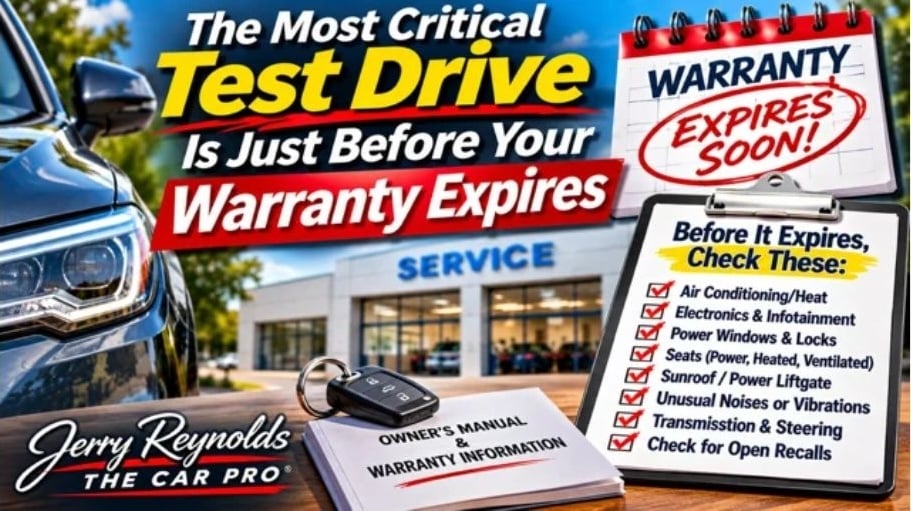

I want you to think about something for a minute. If you bought a new vehicle with a three-year, 36,000-mile bumper-to-bumper warranty, and you're approaching either of those limits, what are you planning to do before that warranty expires? If your answer is nothing because the car seems to be running fine, I want you to reconsider. You may be overlooking one of the easiest opportunities you'll ever have to avoid an expensive repair bill.
I've been in the automobile business most of my adult life, and I've seen this scenario play out more times than I can count. Somebody buys a new vehicle, enjoys it for three years, and never gives the warranty much thought. Then, a few months after the warranty expires, something goes wrong. Maybe it's the air conditioning, a power window, an electronic module or an infotainment screen. Suddenly, what might have been a covered repair becomes an expense the owner has to pay out of pocket.
Sometimes the problem was already developing before the warranty expired, but nobody noticed it or bothered to have it checked.
That's why I have a suggestion that I wish every new-car owner would follow: Schedule a thorough vehicle inspection before your factory warranty runs out.
I'm not talking about your regular oil change or a quick walk around the vehicle. I'm talking about making an appointment with the dealership's service department and asking them to give your vehicle a thorough inspection while it's still under warranty. Ideally, I'd do this several months or a few thousand miles before the warranty expires, rather than waiting until the last possible day.
Now, I want to make an important distinction. Most factory warranties don't cover everything, and they certainly don't cover normal wear and tear. Tires, brake pads, wiper blades and other maintenance items generally aren't covered simply because they need replacement. And just because something is inspected while the vehicle is under warranty doesn't mean the manufacturer will pay to repair it. There must be a covered defect, and the vehicle must meet the applicable warranty requirements.
But if there is a problem developing with a covered component, I'd much rather discover it while the warranty is still in effect.
Let's start with the air conditioning system. Here in Texas, I can tell you that a properly functioning air conditioner isn't a luxury; it's practically a survival tool. But no matter where you live, a weak air conditioner can be an expensive problem. Maybe it isn't cooling quite as well as it did when the vehicle was new, or perhaps you hear an unusual noise when the compressor engages. Those are things worth having checked before your warranty expires.
The same goes for the vehicle's electronics, and today's cars have more of them than ever. Power windows, door locks, seat motors, cameras, sensors, infotainment systems, digital instrument clusters and electronic control modules can all be costly to repair or replace. If something works intermittently, freezes up, makes an unusual noise or doesn't behave the way it should, don't ignore it simply because you can still live with it.
I hear from callers all the time who tell me they've had a problem for months but never mentioned it to the dealership because it wasn't happening every day. Then the warranty expires, the problem becomes more frequent, and they're understandably frustrated when they're told the repair may no longer be covered.
Don't put yourself in that position.
Pay attention to your vehicle in the weeks leading up to the inspection. Turn everything on and make sure it works. Operate every power window. Check the power seats, including the memory functions if equipped. Test the heated and ventilated seats, the heated steering wheel, the sunroof, the power liftgate and any other features your vehicle has. Make sure the backup camera displays properly and that the infotainment system isn't freezing, restarting or losing its connection to your phone.
You might be surprised how many things you haven't used in months.
Then take the vehicle on a meaningful test drive, preferably on several types of roads. Turn the radio off and listen. Do you hear any new rattles, squeaks, clunks or unusual mechanical noises? Does the transmission shift smoothly? Does the steering feel normal? Are there vibrations that weren't there before? Does the vehicle pull to one side, or does the suspension make noise over bumps?
I'm not suggesting you become paranoid about every little sound. Cars make noises, and some are perfectly normal. But if something has changed, now is the time to have it evaluated.
I would also ask the service department to check for fluid leaks, cooling-system problems, suspension concerns and other conditions that could indicate a developing defect. A qualified technician can often identify things the average owner would never notice, especially when the vehicle is on a lift.
Here's another important point: Know exactly when your warranty expires.
Many people assume the warranty clock started when they bought the vehicle, but the manufacturer's original warranty generally begins on the vehicle's warranty start or in-service date, which may be earlier than your purchase date. This can be particularly important with demonstrators, loaner vehicles and certain previously titled vehicles. The mileage limit matters, too, and most warranties expire when either the time or mileage limit is reached, whichever comes first.
Also, don't assume every component has the same coverage. Your vehicle may have a three-year, 36,000-mile limited warranty and a five-year, 60,000-mile powertrain warranty, or some other combination depending on the manufacturer. Emissions components, hybrid batteries, electric-vehicle batteries and certain other parts may have different coverage periods. Corrosion warranties can be different as well.
Take a few minutes to review your warranty booklet or the manufacturer's warranty information for your specific vehicle. If you're not sure, ask the dealership to verify the coverage using your VIN.
While you're at it, have the dealership check for outstanding recalls and applicable service campaigns. Safety recalls are generally repaired at no charge regardless of whether the ordinary factory warranty has expired, subject to applicable legal requirements and remedy availability. Service campaigns and warranty extensions, however, can have their own eligibility rules, time limits and mileage restrictions. It's worth knowing what's available for your vehicle.
One thing I especially want you to do is make sure any concerns you report are documented on the repair order. If your navigation system occasionally freezes, tell the service advisor exactly what happens and how often. If you hear a clunk from the front suspension when backing out of your driveway, describe the circumstances as clearly as possible.
Don't just say, "Check everything."
Be specific, and make sure those concerns appear on the paperwork you receive.
This matters because intermittent problems can be difficult to duplicate. A technician may test the vehicle and find that everything is working normally at that moment. Having the concern documented while the vehicle is still under warranty can be helpful if the problem continues, although I want to be clear that documentation alone does not automatically extend coverage or guarantee a future repair will be paid for.
If a covered problem is identified, make sure you understand the next steps and whether any necessary parts must be ordered. If the dealer cannot complete the repair before the warranty expires, ask how the manufacturer will handle the situation and get the answer documented. Manufacturer policies and warranty terms vary, so don't rely on assumptions.
And please don't wait until you have 35,999 miles on a 36,000-mile warranty to make the appointment. Service departments can be busy, diagnostic work takes time, and some problems require additional testing or parts that aren't immediately available.
I would much rather see you schedule the inspection early enough to allow time for any necessary repairs.
Now, I can already hear somebody saying, "Jerry, why would I take my perfectly good car to the dealership and ask them to find something wrong with it?"
Because there's a difference between looking for trouble and making sure you're not overlooking trouble that's already there.
A thorough inspection doesn't mean the technician should invent problems or recommend unnecessary repairs. In fact, if the service department suggests customer-pay maintenance or repairs, ask whether those items are required by the manufacturer's maintenance schedule, recommended because of an observed condition or covered under warranty. Those are three very different things.
And if the inspection itself carries a charge, find that out when you make the appointment. A factory warranty doesn't necessarily entitle you to a free comprehensive inspection when there is no reported defect.
There's another reason I like this approach. Even if the inspection finds absolutely nothing wrong, you've established a useful baseline for the vehicle's condition. You may learn that your tires are approaching replacement, your brakes have plenty of life remaining or certain maintenance services will be due soon. That information can help you budget for ownership after the warranty expires.
If you're planning to keep the vehicle for another five or six years, that's valuable information.
I also think this is a good time to consider your plans for the vehicle. Are you going to keep it well beyond the factory warranty? If so, you may want to evaluate whether a manufacturer-backed extended service plan or a reputable vehicle service contract makes sense for your driving habits and financial situation. Just remember that those products have their own terms, exclusions, deductibles and eligibility requirements, and they aren't a substitute for addressing existing problems while factory coverage remains.
You don't have to buy anything simply because your warranty is ending.
My goal here is to help you avoid an unpleasant surprise. Nobody likes being told that an expensive repair isn't covered because the warranty expired two months ago, especially if the symptoms were present long before that.
I've always believed that one of the smartest things you can do as a vehicle owner is take care of small problems before they become big ones. The same principle applies to your warranty. Don't wait until it's gone to start wondering whether everything is working properly.
So if your vehicle is approaching the end of its factory warranty, get out your paperwork, check the expiration date and mileage, and schedule an inspection with the dealership. Spend some time checking the features yourself, make a list of anything that doesn't seem right and have those concerns evaluated while coverage is still available.
You may discover a problem that can be repaired under warranty, or you may get the peace of mind that comes from knowing your vehicle is in good condition.
Either outcome is worthwhile.
Because there's nothing more frustrating than discovering a problem you could have addressed yesterday, only to find out that yesterday was the last day of your warranty.