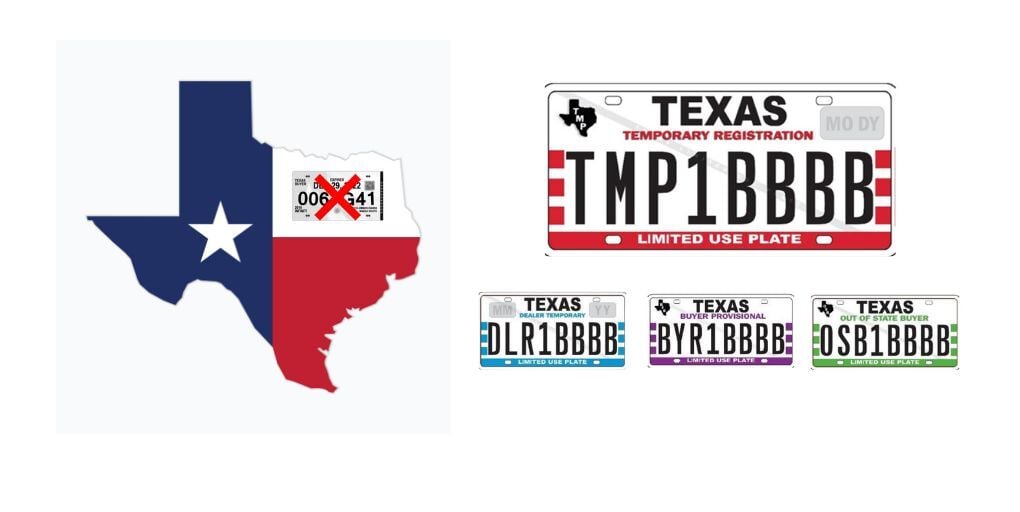

Texas officials are continuing to confront widespread use of fraudulent license plates months after the state eliminated paper temporary tags, a move intended to curb abuse that had made Texas a national symbol of registration fraud.
As we reported last summer, in July 2025, Texas stopped allowing paper temporary license plates, replacing them with metal temporary tags issued by dealerships and county tax offices. The change followed years of complaints from law enforcement agencies that counterfeit paper tags were easy to make, difficult to trace and frequently used to avoid tolls, inspections and police detection.
The reform was aimed at closing a loophole that allowed fake paper tags to circulate freely, often printed online or sold illicitly. But law enforcement officials say the problem has not disappeared. Instead, it has evolved.
According to reporting by Jalopnik and regional media outlets, officers in several Texas counties have encountered counterfeit metal temporary plates that closely resemble legitimate state-issued tags. Some of the fakes are created by applying printed wraps or decals to blank metal plates or to stolen plates, making them difficult to identify during routine traffic stops.
In Harris County, deputies recently stopped a vehicle displaying a red-striped metal temporary tag that appeared legitimate at first glance. A records check showed the plate number was registered to a different vehicle. The driver told authorities he had purchased the tag for about $120 from a private individual. The case remains under investigation, according to law enforcement officials cited by NBC DFW.
Authorities say the new fake tags demonstrate that criminal networks adapted quickly to the state’s transition away from paper plates.
“We’re in the first inning right now,” Travis County Constable Sgt. Joe Escribano told NBC DFW, referring to enforcement efforts under the new system. He noted that counterfeiters appear to be using wraps and overlays to replicate official metal tags rather than forging paper documents.
The elimination of paper tags came after years of mounting concern. State lawmakers passed House Bill 718 during the 2023 legislative session, requiring metal temporary plates for vehicles sold by dealers or awaiting permanent registration. The law was promoted as a major step toward improving road safety and accountability.
Before the change, Texas had become infamous for “paper tag fraud,” with investigators estimating hundreds of thousands — and possibly more than a million — fake temporary tags circulating nationwide. Vehicles using fraudulent tags were frequently linked to toll evasion, uninsured driving, hit-and-run crashes and other criminal activity.
The Texas Auto Dealers Association warned lawmakers during legislative hearings that counterfeiting could continue even after the switch to metal plates if safeguards were insufficient. Association representatives cautioned that criminals would adapt unless enforcement tools and verification systems were improved alongside the physical plates.
Texas Department of Motor Vehicles officials have acknowledged that the transition remains a work in progress. The agency has encouraged law enforcement officers, dealers and consumers to become familiar with the design and security features of the new metal tags and to verify plate numbers through official databases when questions arise.
Law enforcement officials say the realistic appearance of some counterfeit plates poses challenges during traffic stops, where officers often must make quick judgments. As a result, agencies are emphasizing database verification rather than relying solely on visual inspection.
Despite the setbacks, state officials maintain that eliminating paper tags was a necessary step. They argue that metal plates are harder to mass-produce than paper and provide a better foundation for enforcement improvements over time.
The persistence of fake plates underscores a broader challenge facing states nationwide: balancing convenience in vehicle registration with safeguards that prevent fraud. In Texas, authorities say the shift away from paper tags reduced one avenue for abuse, but the fight against counterfeit plates is far from over.
As investigators continue to identify new methods used by counterfeiters, lawmakers and regulators may be forced to consider additional measures to strengthen the system and close remaining gaps.

Photo: Texas DMV/Pixels Pioneer: Shutterstock.com/Canva.