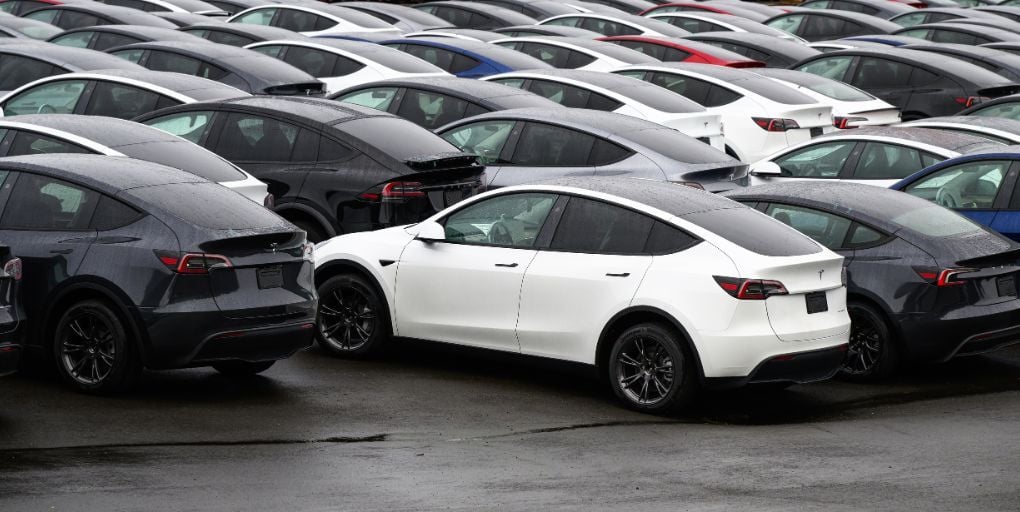

Tesla has lost its position as the world’s largest electric-vehicle maker after global sales declined for a second consecutive year, allowing Chinese automaker BYD to move into the top spot amid intensifying competition and slowing demand for electric vehicles.
Tesla said its worldwide deliveries fell about 9 percent in 2025 to roughly 1.64 million vehicles, down from 2024 and well below the company’s peak growth years earlier in the decade. The decline marks the first time Tesla has posted two straight years of lower annual sales.
By contrast, BYD reported sales of more than 2.2 million battery-electric vehicles during the year, driven primarily by strong demand in China and steady expansion into Europe and other international markets. The results pushed BYD past Tesla as the global EV sales leader.
The shift underscores how quickly the electric-vehicle market is changing. Once defined largely by Tesla’s dominance, the sector has become crowded with competitors offering a wider range of vehicles, often at lower prices, as governments scale back incentives and consumers grow more cautious about higher-priced EV purchases.
Tesla’s struggles were especially pronounced in the United States, its largest market. The expiration of the federal EV tax credit late last year removed a key incentive that had helped offset higher vehicle prices. Without the credit, many buyers faced significantly higher out-of-pocket costs, contributing to softer demand across much of 2025.
At the same time, traditional automakers including General Motors, Hyundai, Kia, Volkswagen and Ford expanded their electric lineups, offering more choices in popular segments such as compact SUVs and midsize sedans. Several of those models undercut Tesla on price, further pressuring the company’s market share.
Tesla’s fourth-quarter results highlighted the trend. The company delivered about 418,000 vehicles in the final three months of 2025, down more than 15 percent from the same period a year earlier and below Wall Street expectations. Analysts said the weaker quarter reflected a combination of slowing demand, rising competition and limited new-product launches.
Chief Executive Elon Musk has acknowledged the challenges while emphasizing Tesla’s long-term strategy. Musk has repeatedly said the company is evolving beyond a traditional automaker, pointing to investments in artificial intelligence, autonomous driving technology, energy storage and robotics.
Late last year, Tesla launched a limited pilot of its long-promised robotaxi service in Austin, Texas, and has sought regulatory approval to expand autonomous ride-hailing in other states. The company also continues development of its Optimus humanoid robot, which Musk has described as a potential major revenue driver in the future.
Investors appear to be betting on that broader vision. Despite the sales decline, Tesla shares finished 2025 higher than where they began the year, reflecting confidence that new technologies could eventually offset slower growth in vehicle deliveries.
Tesla has also taken steps to reignite demand for its core products. The company introduced lower-priced versions of the Model 3 and Model Y, its two best-selling vehicles, as it works to make its lineup more affordable in an increasingly price-sensitive market. Price cuts, however, have weighed on profit margins and raised concerns about longer-term earnings growth.
For BYD, the milestone reflects the rapid rise of Chinese automakers in the global EV race. Backed by a broad product portfolio and tight control over battery production, BYD has benefited from scale and cost advantages that allow it to compete aggressively on price while expanding overseas.
Industry analysts say the changing leaderboard does not signal the end of Tesla’s influence but rather a maturing EV market where no single company dominates. As incentives fade and competition increases, success is increasingly tied to pricing, product variety and execution rather than brand cachet alone.
Tesla remains one of the most recognizable names in electric vehicles, but its loss of the global sales crown illustrates how quickly leadership can shift in an industry still finding its footing.

Editorial Photo: Seattle - Feb. 16, 2025. Ian Dewar Photography/Shutterstock.com.