
I had two callers to my radio show Saturday tell me, politely, that I am wrong about Tesla’s Full Self-Driving system. Both use FSD regularly, both say it works extremely well, and both clearly have tremendous confidence in it.
I listened to them, and I believe them. I learned from them and I am grateful for the information. That does not mean I have completely changed my mind.
I have probably been too dismissive at times about just how good Tesla’s latest Full Self-Driving technology has become. There are owners using it for thousands of miles who report very few interventions, and recent independent road tests have found enormous improvement over earlier versions that I tested. But there is a distinction I think every driver needs to understand: a system can be remarkably capable and still not be autonomous.
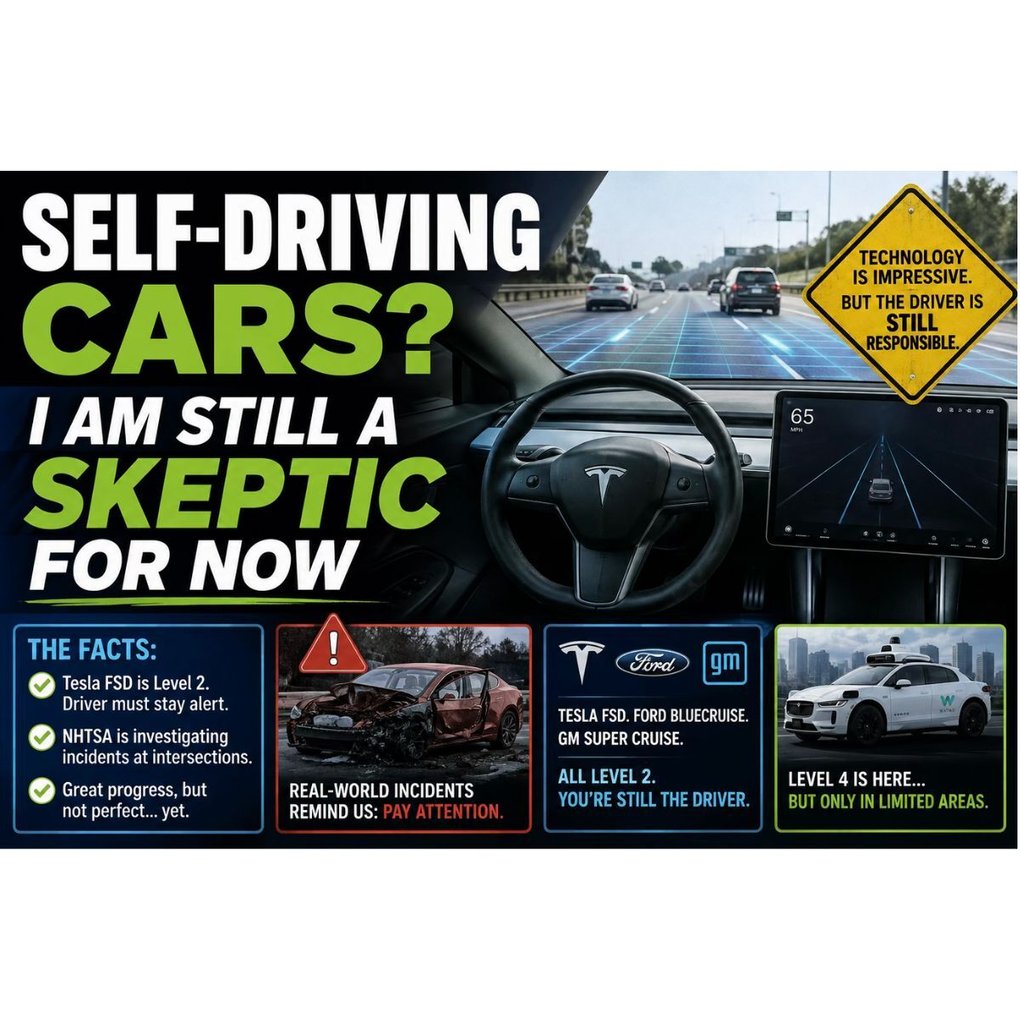
Even Tesla makes that distinction. The product is now formally called Full Self-Driving (Supervised), and Tesla states plainly that it requires an attentive driver, does not make the vehicle autonomous, and requires the driver to remain ready to take control at any moment. Tesla classifies FSD as a Level 2 driver-assistance system.
That “Level 2” designation is important.
Under the automation definitions used by NHTSA and SAE International, Level 2 means the vehicle can control steering and acceleration/braking at the same time, but you are still driving. You are responsible for watching the road, obeying traffic laws and intervening whenever necessary. Take your hands off the wheel if the system permits it, but you cannot take your brain out of the driver's seat.
Tesla FSD is unusually ambitious for a Level 2 system. It can operate on city streets as well as highways, follow a navigation route, change lanes, negotiate intersections and roundabouts, make turns and park. Tesla says its vehicles have accumulated billions of miles using FSD, giving the company an extraordinary amount of real-world data from which to improve the system.
There are some impressive real-world examples. Earlier this year, Tesla publicized a Model 3 owner who completed a coast-to-coast trip of more than 2,700 miles using FSD without an intervention. Business Insider separately reported on the same owner after he accumulated more than 11,000 miles without touching the steering wheel or pedals while FSD was operating. Barron’s tested Tesla’s newer Version 14 software and found it dramatically smoother and more capable than versions the publication had tested in previous years. One of my callers said he went from Midland, TX to DFW in a Cybertruck and didn’t have to intervene at all. It drove itself.
So, when Tesla owners call me and say, “Jerry, you need to try the newest version because it is incredible,” I don't dismiss them. There is plenty of evidence that FSD can perform extraordinarily well for long stretches of real-world driving.
Here is where my skepticism remains.
The system does not have to perform well 99 percent of the time. The problem is the other 1 percent, because the failure may occur at exactly the moment the driver has become convinced the vehicle no longer needs supervision.
NHTSA opened an investigation in October 2025 into reports of Tesla vehicles operating with FSD proceeding through red traffic signals, entering opposing traffic lanes or making other potentially illegal maneuvers. At the time the investigation opened, NHTSA had identified 58 incidents, including 14 crashes and 23 reported injuries. Six reports involved vehicles entering intersections against red lights and subsequently crashing; four of those crashes reportedly resulted in injuries.
Those numbers need context. They are reports being investigated, not findings that FSD was responsible for every crash, and they have to be considered against millions of vehicles and billions of miles of FSD operation. Tesla also continually changes the software through over-the-air updates, meaning the system someone experienced two years ago may bear surprisingly little resemblance to what an owner uses today.
A recent Texas crash illustrates why we must also be careful about blaming automation simply because it was engaged. The NTSB is investigating a June 2026 crash in Katy involving a Tesla Model 3 that had FSD (Supervised) active. The car left a 30-mph residential street and struck a house at more than 70 mph, killing someone inside, and I mentioned this incident on the show Saturday. That sounds terrible for FSD until you read the preliminary NTSB information: electronic data showed that the driver had manually overridden the system by pressing the accelerator pedal to 100 percent before the crash. The investigation is still underway, but that fact alone demonstrates why headlines about crashes involving driver-assistance systems don't always tell the whole story. My Midland caller pointed this out, thank you sir.
Tesla isn't alone in facing this challenge.
Ford’s BlueCruise and GM’s Super Cruise are also Level 2 systems, although they take a somewhat different approach. Both allow hands-free driving under approved conditions while using cameras to monitor whether the driver is watching the road. GM limits Super Cruise primarily to compatible mapped roads and uses cameras, radar, GPS and precision mapping. GM says customers have now driven more than one billion miles using Super Cruise. Ford’s BlueCruise also monitors the driver's eye gaze and head position and warns the driver if attention wanders.
I use Super Cruise often in vehicles I test, and I think it is terrific technology. But it isn't autonomous either, and competitors aren't immune from problems. NHTSA escalated an investigation into Ford BlueCruise-equipped Mustang Mach-Es after crashes involving stationary vehicles in the roadway. That investigation included fatal crashes. Again, an investigation is not a conclusion that BlueCruise caused those crashes, but it reinforces the point that no Level 2 system should be treated as a substitute for an attentive driver.
The Insurance Institute for Highway Safety has also raised concerns about driver-assistance systems across the industry, not just Tesla. When IIHS introduced its partial-automation safeguard ratings, 11 of the first 14 systems it evaluated received a poor overall rating. Tesla, Ford, GM, Mercedes-Benz and several others all had shortcomings of one kind or another. The problem IIHS is trying to address is not simply whether these systems can steer a car successfully. It is whether they do enough to prevent humans from becoming complacent while the technology is doing most of the work.
There actually is a production car in America that crosses into a different category. Mercedes-Benz Drive Pilot is certified as Level 3 conditional automation in California and Nevada. Under very specific conditions on approved highways—daytime, clear weather, no construction and heavy traffic at speeds below 40 mph—the Mercedes system permits the driver to take his or her eyes off the road and perform certain other activities. The system, rather than the human, performs the driving task while those conditions remain satisfied, although the driver must be prepared to take over when requested.
Notice how restrictive that is. Mercedes achieved eyes-off driving not by saying its system can handle virtually any road, but by severely limiting when and where it assumes responsibility.
Then there is Waymo, which helps explain what truly driverless technology looks like. Waymo operates Level 4 autonomous ride-hailing vehicles without a human driver in specific geographic areas. Through March 2026, Waymo reported more than 220 million miles with no human driver aboard. Its published data show substantially fewer injury and serious-injury crashes than human-driver benchmarks in the cities where it operates. Waymo is not selling you a car that will drive autonomously anywhere you want; it operates within carefully defined areas and conditions.
That distinction brings me back to Tesla.
Tesla has chosen perhaps the most ambitious route of anyone: build a system capable of handling an enormous variety of roads and situations using a camera-based approach, put it into customer vehicles, gather vast amounts of real-world data and continuously improve it through software. The progress has been remarkable.
Tesla also says its own data show vehicles using FSD have fewer collisions than vehicles driven without it. I would like to see more independent validation before declaring FSD definitively safer than human driving because comparing crash rates is extraordinarily complicated. Road type, weather, vehicle age, driver demographics and the kinds of miles driven can dramatically affect the results. Tesla's numbers are encouraging, but they remain Tesla's numbers.
So, were my callers wrong Saturday? No.
If they tell me their Teslas routinely take them from home to work, negotiate city streets, enter the freeway, change lanes, exit and arrive at their destination without intervention, I believe them 100%. The capability of the technology today is far beyond what many people who haven't experienced the latest software probably realize.
But I wasn't entirely wrong either.
My concern has never been that these systems can't drive extremely well. My concern is that when they drive extremely well day after day, humans inevitably begin trusting them more than the manufacturers themselves say they should. As I said on the air, they get complacent. That is the danger and it can be deadly.
Use FSD. Use Super Cruise. Use BlueCruise. Enjoy what I consider some of the most remarkable automotive technology developed in my lifetime. These systems can reduce fatigue and make long drives considerably more enjoyable, and I believe they will continue improving rapidly.
Just understand which seat you're sitting in.
If you're using Tesla Full Self-Driving (Supervised), Ford BlueCruise or GM Super Cruise, you're still the driver. The computer is helping you drive the car, that’s all.
When the day arrives when you can legally climb into your own vehicle, tell it where you want to go, close your eyes and take a nap while it assumes responsibility for getting you there, I'll gladly call that Full Self-Driving.
We aren't there yet.
.jpg?width=150&name=jerry-headshot.jpg%20(1).jpg)