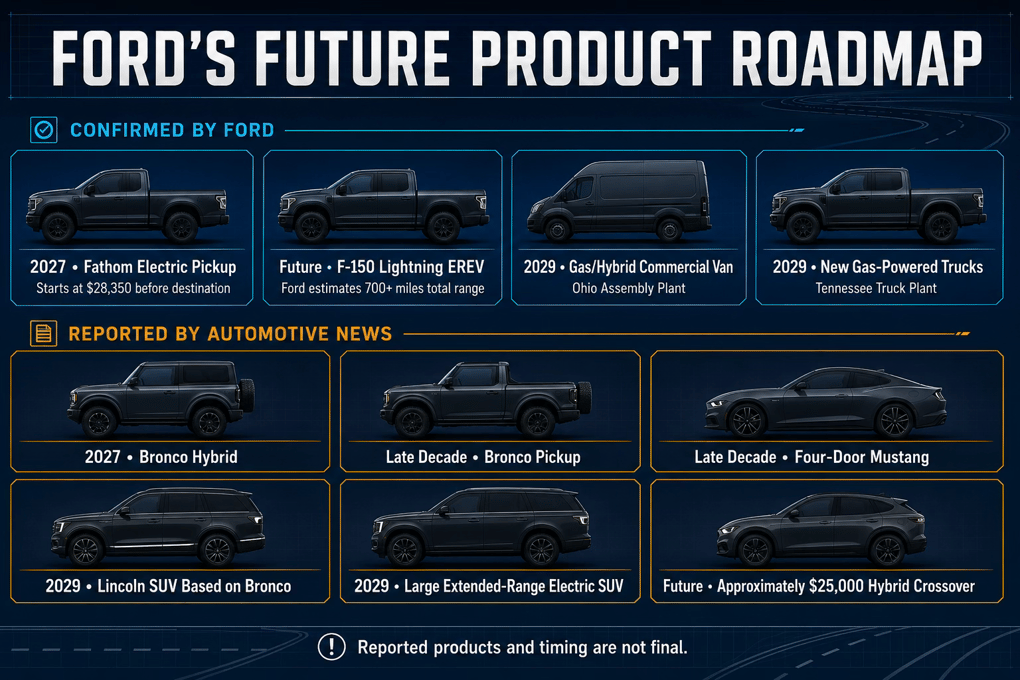

Ford is preparing a sweeping product expansion that reportedly includes a Bronco-based pickup, a four-door Mustang, an affordable hybrid crossover and a new gasoline-and-hybrid commercial van. The automaker also plans to add more extended-range electric vehicles as it redirects billions of dollars away from some of its earlier battery-electric programs.
The future-product details come from Automotive News, which cited people familiar with Ford’s plans who were not authorized to discuss them publicly. Ford has confirmed the broader changes to its manufacturing and powertrain strategy, but it has not formally announced many of the individual vehicles. That means production schedules, model names and other details could still change.
The shift follows a difficult period for Ford’s electric vehicle business. Slower-than-anticipated EV demand, high development costs, regulatory changes and the elimination of federal consumer incentives weakened the business case for several planned models. In December 2025, Ford announced that it expected to record approximately $19.5 billion in special charges related to the restructuring of its electric vehicle operations.
Ford ended production of the current fully electric F-150 Lightning and canceled a planned next-generation full-size electric pickup. However, the Lightning name is expected to return on an extended-range electric truck that uses electric motors to drive the wheels and a gasoline engine to generate electricity when needed. Ford estimates that the next Lightning will provide more than 700 miles of total driving range.
For its conventional EV business, Ford is concentrating on the lower-cost Universal Electric Vehicle platform. The first model will be the recently named Ford Fathom, a midsize electric pickup scheduled to enter production in Louisville, Kentucky, in 2027. Ford says the standard-range Fathom will carry a starting MSRP of $28,350 before destination charges, with preorders opening early next year. The new platform is designed to support an eventual family of smaller and more affordable electric vehicles.
At the same time, Ford intends to expand its most recognizable nameplates into complete vehicle families. The approach can already be seen with the Mustang, which includes the traditional sports car and the Mustang Mach-E electric crossover, and with Bronco, which currently includes the two-door and four-door Bronco SUVs and the smaller Bronco Sport.
According to Automotive News, Ford plans to add a hybrid version of the Bronco in 2027, followed by a Bronco-based pickup closer to the end of the decade. The pickup would be assembled at Michigan Assembly Plant, which currently produces both the Bronco and Ranger.
Ford reportedly intends to dedicate Michigan Assembly entirely to products connected to the Bronco family. A future Lincoln SUV based on the Bronco platform also is scheduled to enter production there in 2029, according to the publication.
A Bronco pickup would give Ford a direct rival to the Jeep Gladiator and allow the company to take further advantage of the Bronco’s off-road image. Ford considered a Bronco pickup earlier in the current model’s development but canceled that project before production.
The future of the Ranger is less clear. Automotive News reports that Ford currently has no plans to build the next-generation Ranger at Michigan Assembly. Ford has confirmed that its Tennessee Truck Plant at BlueOval City will begin producing new gasoline-powered trucks in 2029, and sources say one of those vehicles will be a gasoline-and-hybrid pickup approximately the same size as the Ranger.
Ford could move the Ranger name to Tennessee, which would make sense considering its recognition in the United States and international markets. However, the company could instead give the new Tennessee-built pickup a different name. Ford has not confirmed either possibility, so reports that the Ranger is definitely being discontinued or replaced would be premature.
The Tennessee factory also is reportedly scheduled to build a large SUV with an extended-range electric powertrain beginning in 2029. People familiar with the project told Automotive News that the vehicle could be slightly larger than today’s Expedition, placing it closer in size to the former Ford Excursion. Ford has not said whether it is considering reviving the Excursion name.
Mustang is expected to become a larger family as well. Automotive News previously reported that Ford showed dealers a four-door Mustang concept during a meeting this summer. The vehicle is expected to arrive near the end of the decade, although Ford has not publicly confirmed its body style, powertrain choices, specifications or production date.
The four-door model would represent one of the most significant expansions in Mustang history. The key for Ford will be convincing traditional Mustang enthusiasts that the vehicle is a genuine performance model and not simply another sedan borrowing a famous name. Mustang fans can be a forgiving group—as long as nobody tampers with the horse.
Ford also is attempting to address the industry’s affordability problem. Automotive News reports that the company is developing a hybrid crossover with a targeted price of approximately $25,000. It is expected to be produced at Ford’s Hermosillo plant in Mexico.
A dealer who saw an early mock-up in August described the crossover as resembling the first-generation Ford Escape. Ford had planned to build a revived Transit Connect at Hermosillo but reportedly canceled that project to make room for the more affordable hybrid crossover.
Ford is not abandoning the smaller commercial-van market, however. The company has confirmed that Ohio Assembly Plant will begin producing a new gasoline-and-hybrid commercial van in 2029. People who have seen early prototypes told Automotive News that the vehicle is larger than the compact Transit Connect, which Ford discontinued in the United States after the 2023 model year, but smaller than the full-size Transit. Its dimensions are reportedly closer to those of the Transit Custom currently sold in Europe.
The overall plan combines traditional gasoline engines, hybrids, fully electric vehicles and extended-range EVs rather than attempting to move every buyer toward one powertrain. Ford says it will refresh 80% of its North American product portfolio by volume by 2029 and introduce five affordable vehicles by the end of the decade. The company also has said it intends to offer five vehicles priced below $40,000.
By 2030, Ford expects hybrids, fully electric vehicles and extended-range EVs to account for approximately half its global sales volume, up from 17% in 2025.
The individual products have not all received Ford’s official approval stamp, but the broader direction is unmistakable. Ford is betting heavily on trucks, vans, hybrids and its best-known names while taking a more selective approach to fully electric vehicles. If everything now planned reaches showrooms, buyers will see a much larger Bronco family, a Mustang with four doors, a new generation of affordable vehicles and considerably more choice under the hood.
.jpg?width=150&name=jerry-headshot.jpg%20(1).jpg)