
Each week I bring you the top stories in the auto industry along with my commentary or sometimes amusing thoughts about the craziness that goes on in the world of cars. Here is this week’s edition:
Stories you’ll find today:
- Don’t Be a Dipstick: Why Your New Car Doesn’t Have One
- From Robo Dreams to Used Car Schemes
- Waffle House Gets Charged: Now Serving Hashbrowns, Grits, and Gigawatts
- 1,000 People, One Steering Wheel, Zero Direction
Don’t Be a Dipstick: Why Your New Car Doesn’t Have One. Gone are the days when checking your car's oil meant popping the hood and pulling out a dipstick like a proud mechanic-in-training; now, in the age of sensors and software, many new cars have banished the humble dipstick entirely, replacing it with electronic oil level monitors that beep, buzz, or light up when your engine needs a drink—because apparently, lifting a little metal rod was just too much to ask. Automakers argue that sensors provide more precise readings and protect the engine from user error, but for drivers who like to see things for themselves (and perhaps feel useful for five minutes), this shift feels less like progress and more like losing a basic survival skill—like being told you can no longer check if your coffee is hot because your mug now emails you the temperature. The trend started with luxury brands like Mercedes-Benz, who decided the average driver shouldn’t be trusted with a rag and a metal stick, and quickly spread to other automakers who figured fewer moving parts meant fewer warranty claims and less chance for someone to overfill their engine and blame the car. But as Jalopnik.com points out, these sensors aren’t always perfect; some report oil levels that vary wildly, while others decide to panic only after your engine is already impersonating a frying pan, which is not ideal if you’re halfway to Grandma’s house and your only backup is a blinking warning light and a phone signal that left the building six miles ago. What’s more, some cars still have dipsticks for transmission fluid, but they’re now buried behind plastic covers and bolts like a forbidden treasure, as if automakers really want you to pay someone else to touch your own car. It’s all part of a broader push to make vehicles feel more like sealed tech gadgets and less like machines you can understand, but it also robs drivers of a little agency—and a little pride. Sure, dipsticks might’ve been a bit messy and not exactly glamorous, but they gave you direct access to your car’s mechanical lifeblood, and they never failed because of a glitch, dead battery, or software update. So, here’s to the dipstick: may it rest in peace in the junk drawers of the mechanically curious, fondly remembered by anyone who ever said “yep, looks good” even when they had no idea what they were looking at.
From Robo Dreams to Used Car Schemes. Back in 2019, Tesla told its U.S. lessees something bold: when your Model 3 lease is up, you can’t buy it, because we’re going to turn it into a fully autonomous robotaxi. Yes, every base Model 3 with cloth seats and a faint smell of gym socks was apparently destined for a glorious new life shuttling strangers around in a fleet that Elon Musk promised would number over a million by 2020. That was the plan—until it wasn’t. As it turns out, those robotaxis never came. What did come was a steady supply of returned off-lease Teslas, which the company quietly began selling instead, often with a cherry on top: a “Full Self-Driving” software package and maybe even an acceleration boost—none of which turned the car into a robotaxi, but did help jack up the resale price. So much for the Robo-Future. The truth is, while Tesla was holding customers’ lease-end rights hostage in the name of autonomy, it was really just staging a resale rollout. Customers who might’ve expected to buy their well-worn Model 3s at the end of the term—presumably because they liked the car or just didn’t want to give it back with a cracked center console cover—were told no dice. Tesla wanted the car for its grand AI mission. Then Tesla slapped a new price tag on it and resold it to someone else. The twist? The new buyer might’ve paid more than the original lessee would have. Plot twist, or business genius? By late 2023, amid falling used EV prices and increasing competition, Tesla quietly dropped the robotaxi excuse and started letting new lessees buy their cars again. No dramatic press release, no grand declaration of “mission complete”—just a policy change as quiet as a Model S pulling out of a Whole Foods parking lot. The whole saga highlights what happens when high-tech dreams meet low-mileage realities. The grand robotaxi vision may have stalled somewhere between FSD Beta 9.999 and a disengagement report, but at least the cars found new homes—just not the kind that pick up rides autonomously while you sleep. For customers, it was a lesson in expectations. For Tesla, it was a reminder that if you can’t launch a fleet of one million autonomous vehicles, you can always pivot to flipping lightly-used EVs with pricey software upgrades. And hey, if the self-driving dream ever does pan out, Tesla can always lease the same cars again—this time to the robotaxis themselves.
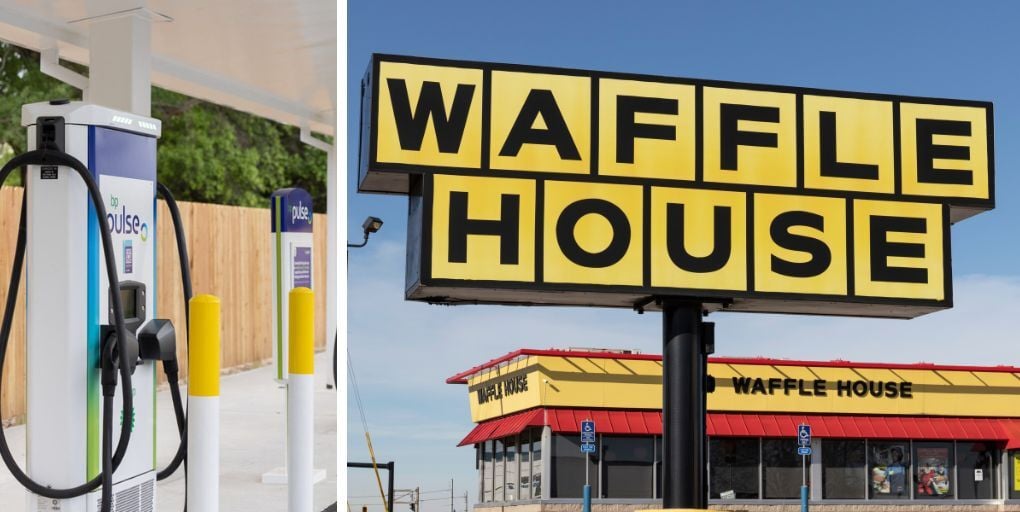
Waffle House Gets Charged: Now Serving Hashbrowns, Grits, and Gigawatts. America’s favorite 24/7 roadside refuge is entering the electric age—because what pairs better with a pecan waffle than 400 kilowatts of direct current? That’s right, Waffle House is plugging in—literally—thanks to a new partnership with BP Pulse to bring ultrafast EV chargers to select locations starting in 2026. Soon, your Tesla, Rivian, or “whatever-that-new-startup-car-is-called” can fuel up while you fuel up on bacon and syrup. Picture it: you're barreling down I-75, battery warning light flashing, hunger gnawing at your soul, Spotify repeating the same three songs from your high school road trip playlist. Salvation appears in the form of a glowing yellow sign. You pull into a Waffle House, jack in your EV with a CCS or NACS plug, and settle in with a smothered, covered, and peppered hashbrown extravaganza. By the time you’re licking the syrup off your fork, your car’s ready to hit the road again—fueled by waffle energy and electrons. Each location will offer six 400kW DC fast chargers, which is fast enough to bring your EV from “panic” to “let’s roll” in the time it takes to finish your eggs (or at least your second coffee refill). And unlike some sterile charging stations tucked behind a strip mall dumpster, these chargers come with live-action griddle clatter, the faint smell of sausage, and a 95% chance someone named “Debbie” calls you “hon.” Why Waffle House, you ask? Because it never closes, it’s everywhere from Florida to Texas, and if there's one thing both EVs and road-tripping humans need, it’s a reliable place to recharge. Plus, it's about time someone combined the thrill of high-voltage current with the allure of a laminated menu stuck to the table. BP Pulse says this is part of a bigger plan to expand EV infrastructure along travel corridors, but let’s be honest—this is also the most Southern way imaginable to go green. It's not a Supercharger station, it’s a Supercharged Sausage Station. So the next time you’re cruising in your electric chariot and need a place to power up, forget the gas stations and welcome to the new era of travel: where your breakfast gets topped, your battery gets topped off, and your arteries and alternator are equally full. New Motto: Waffle House: open all night, and now open to the future.
1,000 People, One Steering Wheel, Zero Direction. Nearly 1,000 strangers are road-tripping across America without leaving their couches, thanks to a new browser game called Internet Roadtrip that lets users steer a virtual car across the country using Google Maps Street View—one collective vote at a time. Created by web developer Neal Agarwal, the experience is like herding digital cats through a highway of indecision, as players vote every few seconds on which direction to take, turning the entire U.S. into a giant choose-your-own-adventure with zero gas bills and absolutely no bathroom breaks. The trip kicked off in Boston, which was already a bold move considering navigating that city is difficult enough with an actual steering wheel, and by the time of reporting, the digital caravan had made it a whopping 450 miles to scenic Scarborough, Maine—famous for being not at all on the way to California. The controls are simple: users see Street View images, vote on where to go, watch a cartoon steering wheel react like it's possessed, and argue in a chat window that feels like AIM never died. There's even a radio station, but like everything else, you’ll need a group consensus to change it—so if someone picks polka, you’re probably stuck with it until Nevada. Sometimes, democracy means driving directly into a Walgreens parking lot for no reason, and other times it means getting stuck in a neighborhood cul-de-sac because everyone panicked at a four-way stop. Still, there’s something oddly beautiful about watching total strangers agree to virtually drive in circles for hours at a time, all in the name of progress. Whether the group ends up in California or accidentally detours through Canada, one thing’s for sure—this is the only road trip where nobody’s fighting over snacks or asking “are we there yet,” mostly because no one has any idea where “there” actually is.
Photo Credit: BP Pulse (left) and Editorial Use Only: Dayton - Circa November 2021. Jonathan Weis/ Shutterstock.com (right).
.jpg?width=150&name=jerry-headshot.jpg%20(1).jpg)