
Each week I bring you the top stories in the auto industry along with my commentary or sometimes amusing thoughts about the craziness that goes on in the world of cars.
Stories you’ll find today:
- Ford Ranger EV Owners Staged a Sit-In—and Won
- Flock Around and Find Out
- Dallas Garbage Trucks Become Code Inspectors
- LAPD Throws a Tow-Truck Convention
FORD RANGER EV OWNERS STAGED A SIT-IN—AND WON
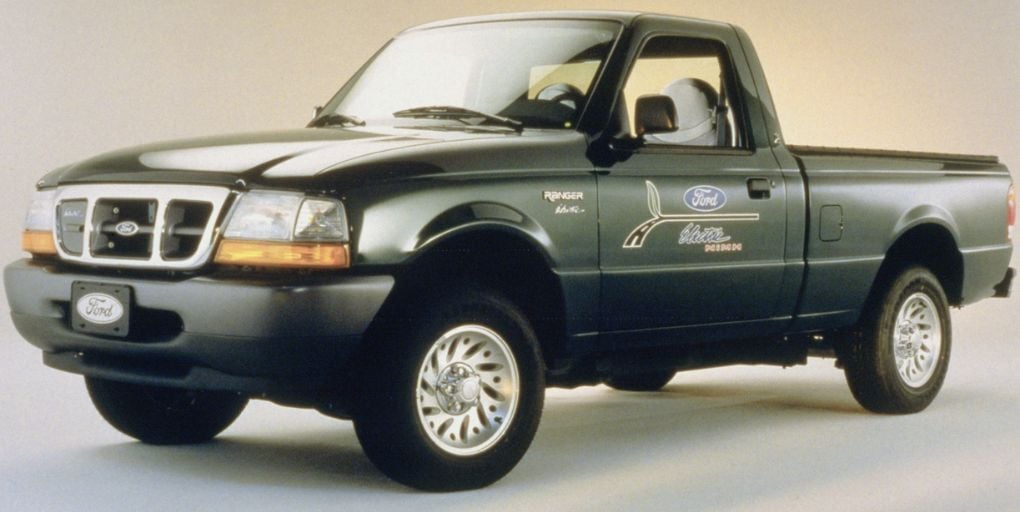
Long before the F-150 Lightning and Ford’s upcoming Fathom electric pickup, Ford already had an EV truck with owners willing to fight for it. From 1998 through 2002, Ford produced about 1,500 all-electric Rangers, primarily for California, to help comply with the state’s zero-emission requirements. Most weren’t sold; they were leased, and when Ford ended the program, it planned to take the trucks back. The people driving them had other ideas. In 2005, Ranger EV supporters staged a seven-day sit-in at Downtown Ford in Sacramento, California, protesting Ford’s plan and trying to keep the pickups from meeting the same crusher fate as many GM EV1s. It worked—at least partly. Ford still killed the Ranger EV program, but it agreed to let current lessees buy their trucks for the princely sum of $1, with no warranty. Former lessees could enter a lottery to buy refurbished Rangers for $6,000. The little electric pickup was hardly a Rivian: early versions used a 23-kWh lead-acid battery and had an EPA range of about 50 miles. Ford later switched to nickel-metal hydride batteries, and the rear-drive Ranger EV produced just 90 horsepower and 140 pound-feet of torque. Ford claimed a 700-pound payload, and some owners apparently worked them hard—two cattle ranchers involved in the protest said their Ranger EV once pulled a stuck forklift out of the mud when their diesel pickup couldn’t. So as Ford prepares another chapter in its electric-pickup history with the Fathom, it is worth remembering the little Ranger EV. Twenty-one years ago, Ford customers liked an electric pickup so much they occupied a dealership for a week to keep Ford from taking it away. And at $1 apiece, I’m guessing nobody complained about dealer markup.
FLOCK AROUND AND FIND OUT
Flock Safety has long defended its network of more than 120,000 license-plate-reading cameras by pointing out that they photograph vehicles in public places, where people generally have no expectation of privacy. That argument got an interesting real-world test when InvestigateTV reporter Brendan Keefe decided to film a Flock contractor working on a camera near Keefe’s home outside Atlanta. Keefe said his daughter tipped him off about the worker, so he pulled over some distance away, put on his media credentials and set up a camera. According to the report, Keefe never spoke to or interacted with the contractor. The worker packed up and drove away, and Keefe followed at a distance hoping to get additional video of him working at another location. Instead, Milton police pulled Keefe over after the contractor called 911 and reported that Keefe was following and harassing him. Keefe cooperated and explained to officers that he was a journalist gathering video in public and believed what he was doing was protected by the First Amendment. He also pointed out the rather hard-to-miss irony: the contractor apparently felt harassed because someone was photographing him in public while he was installing equipment designed to photograph everybody else in public. Three officers spent 17 minutes investigating before allowing Keefe to leave, and no citation was issued. It’s no secret that Flock cameras have increasingly become targets of public criticism and even vandalism, so it is understandable that an installer might be cautious. But Keefe’s dashcam reportedly showed him keeping his distance, wearing a safety vest and media credentials, and never confronting the worker. I’m not sure there’s a better advertisement for the privacy debate surrounding automated license-plate readers. Flock’s position is essentially that when you’re in public, cameras happen. Apparently that argument sounds a little different when you’re the one in the picture.
DALLAS GARBAGE TRUCKS BECOME CODE INSPECTORS
If you live in Dallas, that garbage truck rolling past your house may be doing more than collecting brush and bulky trash—it may also be checking up on you. Dallas has equipped 50 sanitation trucks with two side-facing, AI-powered cameras apiece that photograph properties from the public right-of-way and scan the images for potential code violations. According to records obtained by NBC 5 Investigates, the system has already flagged more than 21,000 properties and assigns suspected violations a “blight score” from 1 to 4 based on severity. Among the things the technology can flag are grass height, debris, branches and paint issues. The city says humans review the AI detections before deciding whether property owners should receive notices, and roughly 1,800 courtesy notices had been issued when the story was reported. Those notices can eventually lead to fines if violations aren’t corrected. Dallas began testing the cameras in April and expanded their use over the summer as part of a three-year, $2.5 million contract with City Detect. City officials say the idea is to make code enforcement faster and more efficient, while some residents and privacy advocates aren’t thrilled about municipal garbage trucks photographing homes and assigning them scores. There are some privacy protections: faces and license plates are blurred, and City Detect says the system isn’t connected to law enforcement or federal databases. Still, the program has generated enough controversy that Dallas City Council member Chad West proposed eliminating its funding before tabling the request after the city manager agreed to a hearing on the issue in December. We’ve reached an interesting point in automotive technology when the truck picking up your old sofa can simultaneously decide your grass needs attention. So, on trash day in Dallas, remember three things: roll out the bin, move the branches and smile—you may be getting your picture taken.
LAPD THROWS A TOW-TRUCK CONVENTION
Los Angeles police apparently decided that chasing street-takeover participants one car at a time wasn’t getting the job done, so over Labor Day weekend they tried something considerably bigger.LAPD’s “Operation Street Sweeper” used more than 150 officers, intelligence gathering, social-media monitoring and drones to track four planned street takeovers before more than 700 people eventually gathered near South Figueroa Street and West Alondra Boulevard for burnouts and other stunts. Police waited, surrounded the gathering and then brought in some serious consequences. The operation resulted in 69 arrests, most for allegedly participating in or aiding a street race or takeover, along with 570 citations. Of those, 442 were for spectating a speed contest or exhibition of speed, while 128 juveniles were cited for curfew violations. Police also recovered seven firearms and canisters of nitrous oxide, and one vehicle caught fire. But the number that really jumps off the page is 200—the number of vehicles police impounded. Many were placed on 30-day holds, and reports show that towing, storage and city administrative fees could push the cost to roughly $2,500 for the full month. LAPD Chief Jim McDonnell says Operation Street Sweeper wasn’t a one-time event, and he is pushing legislation that could eventually allow Los Angeles to crush vehicles used in takeovers, although he acknowledged that some involved vehicles can be stolen, rented or borrowed from unsuspecting family members. Whatever you think about street takeovers, 200 impounded cars in one operation sends a pretty clear message. If you insist on doing doughnuts in a Los Angeles intersection, there’s a decent chance the next person driving your car will be a tow-truck operator.

.jpg?width=150&name=jerry-headshot.jpg%20(1).jpg)