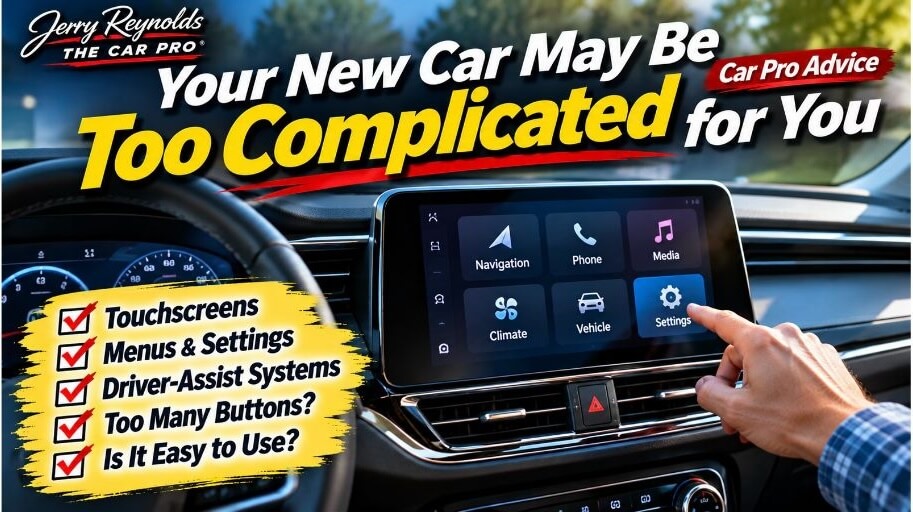

I drive a different new vehicle every week, and after all these years, I still get excited when a new one shows up in my driveway. I love seeing what the automakers have come up with, how the technology has improved, and what new features they've added. Some of the things today's cars can do would have seemed like science fiction when I first got into the automobile business. But lately, I've noticed something that concerns me, and I think it's something every new-car shopper needs to consider.
Are we reaching the point where cars are becoming too complicated for their own good?
I'm not talking about the mechanical side of things. I'm talking about the experience of simply operating the vehicle. Changing the radio station, adjusting the temperature, turning on the heated seats or figuring out how to use the cruise control. Things that used to be accomplished with the push of a button or the turn of a knob can now require navigating through multiple screens and menus.
And sometimes, even after I've spent several days with a vehicle, I still find myself wondering why the manufacturer made something so simple so difficult.
Now, before somebody accuses me of being opposed to technology, let me assure you that's not the case. I love technology. I appreciate the incredible advances we've seen in safety systems, navigation, cameras, connectivity and driver assistance. There are features available today that genuinely make driving safer, easier and more enjoyable, and I wouldn't want to go backward.
But there's a difference between technology that makes your life easier and technology that makes you work harder just to accomplish something simple.
Take climate controls, for example. For decades, you could reach over, turn a knob and adjust the temperature without taking your eyes off the road. You knew exactly where that knob was because it was always in the same place. Today, some vehicles require you to touch a screen, open a climate menu and make your adjustment there. If you want to change the fan speed or direct the airflow somewhere else, that may require another step.
Is that progress? I'm not so sure.
I've driven vehicles with beautifully designed interiors and enormous screens that look absolutely spectacular when you first sit down. But after a few days, I find myself wishing for a simple volume knob or a physical button to turn on the heated steering wheel. I don't need an elaborate digital experience every time I want to change the temperature by two degrees.
And here's what concerns me most: Every time you're looking at a screen to find a control, you're not looking at the road.
That doesn't mean every touchscreen is dangerous or that physical buttons are automatically better in every situation. A well-designed screen can make complicated functions easier to understand, and voice commands can sometimes reduce the need to touch anything at all. But the design should make commonly used functions easy to access, not bury them where drivers have to hunt for them.
Another area where I see growing complexity is the instrument cluster. Many new vehicles have fully digital displays that can be configured in seemingly endless ways. You can change the layout, select different information screens, display navigation instructions and customize what you see.
That's wonderful if you enjoy experimenting with technology.
But I've also driven vehicles where finding a simple piece of information, such as the trip odometer or average fuel economy, requires more button pushing than I think should be necessary. And don't get me started on steering wheels with so many switches that you need a training course to remember what they all do.
Then there's the growing number of driver-assistance systems.
Adaptive cruise control, lane-centering assistance, blind-spot monitoring, automatic emergency braking and other technologies can be tremendously valuable. I'm a big believer in safety equipment, and I think many of these systems have helped prevent crashes and injuries.
But they also come with a responsibility that too many buyers overlook: You need to understand what the systems do, what they don't do and how to operate them properly.
I've talked to people who have owned a vehicle for months and still don't understand how to activate adaptive cruise control. Others don't know why their steering wheel occasionally seems to resist a lane change or why the vehicle sounds an alert when they get too close to a lane marking.
Some owners become so frustrated that they turn off useful features without ever learning how they work. Others assume the technology can do more than it actually can, which is an entirely different concern.
Neither situation is good.
And this isn't just an issue for older drivers. I've seen plenty of younger people who are extremely comfortable with smartphones and computers but still struggle with the controls in certain new vehicles. Being good with technology doesn't necessarily mean you want to navigate a complicated menu while traveling 70 miles per hour.
Here's another thing I've noticed: Automakers don't all approach technology the same way. Some manufacturers have done an excellent job combining modern screens with physical controls for the functions drivers use most often. Others seem determined to eliminate every button they can find.
That's why I think technology and ease of operation should become major considerations when you're shopping for a new vehicle.
Most people spend a lot of time researching horsepower, fuel economy, safety ratings, pricing and reliability. Those things are important, and I certainly want you to consider them. But I also want you to spend some serious time sitting in the driver's seat with the vehicle parked and learning how everything works.
Don't just admire the beautiful screen. Use it.
Change the radio station. Pair your phone. Adjust the temperature. Turn on the heated and ventilated seats. Find the defroster controls. Set up the navigation system. Figure out how to change the information displayed in the instrument cluster. Try the voice commands. Learn how the cruise control operates and how to adjust the driver-assistance settings.
If you have to ask the salesperson how to accomplish something, that's perfectly fine. In fact, that's exactly what a good salesperson is there for.
But here's the question I want you to ask yourself: After somebody shows me how to do this, will I remember it tomorrow?
That's a much more important question than whether the screen looks impressive in the showroom.
I would also encourage you to have the salesperson demonstrate the technology while the vehicle is parked, then try the appropriate functions yourself during a meaningful test drive. It's one thing to navigate a menu while sitting still. It's quite another to operate the vehicle comfortably while paying attention to traffic, pedestrians and everything else happening around you.
And don't forget about the other people who will drive the vehicle.
If your spouse is going to drive it regularly, make sure he or she is comfortable with the controls, too. I've seen situations where one person absolutely loves the technology in a vehicle while the other person can't stand it. That's something you want to discover before the purchase, not six months afterward.
There's also an important distinction between learning a new system and living with a poorly designed one. Any unfamiliar vehicle requires some adjustment, and I don't want people rejecting an otherwise excellent automobile simply because the controls are different from what they're accustomed to. Give yourself enough time to learn the basics.
But if you've spent a reasonable amount of time with the vehicle and still find ordinary functions frustrating, pay attention to that feeling. You may be experiencing something that will irritate you every single day you own it.
One of the things I always recommend is taking advantage of the delivery process. A good dealership should be willing to spend time explaining the vehicle's features and helping you set everything up. That includes pairing your phone, customizing the displays, adjusting safety-system settings where appropriate and making sure you understand the controls.
And if you get home and forget something, don't be embarrassed to call your salesperson and ask for another demonstration. You can also consult the owner's manual, the manufacturer's instructional videos and other reliable resources. Many automakers have excellent tutorials that explain individual features step by step.
I've said for years that you should never leave a dealership without understanding the vehicle you're buying. With today's technology, I believe that's more important than ever.
I also think manufacturers need to remember something about the people who buy their vehicles. Not everybody wants the same experience. Some customers love having everything controlled through a touchscreen. Others prefer physical buttons and knobs. Some want to customize every setting, while others simply want to get in, start the engine and drive.
Neither group is wrong.
The automobile industry has spent billions developing incredible technology, and much of it deserves praise. But the ultimate goal should be to make the driving experience better, not simply to demonstrate how many functions can be moved onto a screen.
A vehicle can have the most advanced infotainment system in the world, but if the owner struggles to turn on the defroster, something has gone wrong in the design process.
I don't want you to misunderstand my message. I'm not suggesting you avoid new technology or buy an older vehicle simply because it's easier to operate. I want you to enjoy the benefits of modern automobiles. I want you to appreciate the safety features, convenience and comfort that engineers have worked so hard to develop.
I just want you to make sure the technology works for you instead of the other way around.
The next time you're shopping for a new vehicle, spend at least 30 minutes exploring the controls before you make your decision. Don't let the salesperson do everything for you. Put your hands on the controls, navigate the menus and see whether the system makes sense.
And if you find yourself becoming frustrated while the vehicle is still sitting on the showroom floor, imagine how you'll feel trying to operate it in rush-hour traffic.
After decades in the car business and hundreds of new vehicles passing through my hands, I've come to appreciate something that doesn't always get enough attention in today's automobile industry.
The best technology isn't necessarily the technology that does the most. It's the technology that makes driving easier without making you think about it.
Because no matter how smart your new car is, it shouldn't require you to become a computer expert just to enjoy driving it.