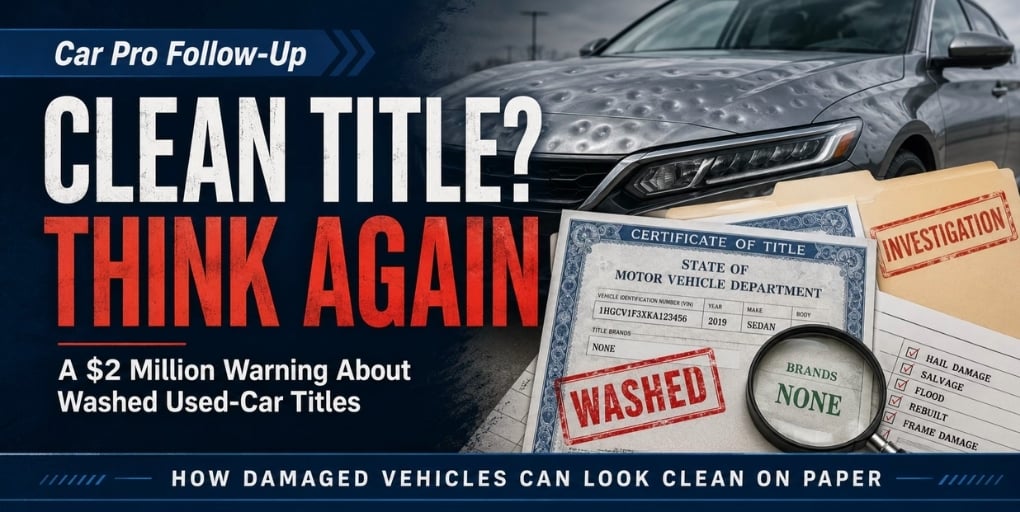

In my July 21st Car Pro Advice column, I urged readers to think twice before buying a salvage-title vehicle. My point was not that every repaired salvage vehicle is automatically bad, but that the lower price can come with serious questions about repair quality, safety, insurance, financing and future resale value. A newly reported Wyoming criminal case adds another warning: Sometimes the biggest risk is not a vehicle carrying a branded title. It is a damaged vehicle whose paperwork allegedly has been manipulated so the brand disappears.
Used Car News reports that Scott Keith Pryor, owner of The Good Car Dealer in Salt Lake City, faces 15 felony charges in Wyoming involving the alleged falsification, alteration, forgery or counterfeiting of vehicle title documents. The charges grew out of an investigation into hail-damaged vehicles purchased after a massive storm struck Cheyenne, Wyoming, on Aug. 1, 2025. Pryor is presumed innocent unless proven guilty.
According to court records cited by Used Car News and Cowboy State Daily, the investigation focuses on 15 Wyoming vehicles purchased through Copart auctions after insurance companies took possession of them. Some reportedly were sold with “parts-only” bills of sale rather than conventional titles. That designation is far more serious than a warning about a badly dented hood. A parts-only vehicle is not supposed to return to the road as a registerable and insurable automobile. Its legal future is supposed to be dismantling, not retailing.
Wyoming Department of Transportation investigator Shane Fox wrote that Pryor had purchased approximately 292 vehicles valued at nearly $2 million through Copart during the previous 12 months. That does not mean all 292 vehicles are part of the criminal charges. The filed charges concern 15 vehicles, but the larger volume reportedly prompted investigators to look closely at the paperwork and the path those vehicles followed after auction.
The case allegedly began to unravel when employees in the Laramie County Clerk’s Office noticed unusual duplicate-title applications. The applications claimed original titles had been lost, but investigators say some supporting signatures were forged and some notary seals were counterfeit. One active-duty Air Force member reportedly told investigators he had not signed the application bearing his name. Notaries whose names appeared on other documents allegedly said they had neither signed nor stamped them.
Then investigators found a detail that sounds as though it came from a television crime drama. One duplicate-title application, dated March 5, 2026, reportedly carried the signature of a Wyoming woman who had died on July 12, 2025—nearly three weeks before the hailstorm that damaged the vehicle. Even in the strange world of government paperwork, a dead owner applying for a duplicate title eight months after her death tends to attract attention.
Investigators allege the duplicate-title process was used to obtain Wyoming titles that did not disclose the vehicles’ earlier parts-only or salvage histories. The affidavit further alleges that vehicles were later sold to buyers in Utah with unbranded titles and at a profit. Again, those are allegations, but they demonstrate why a clean-looking title should never be the only document a used-car buyer trusts.
Wyoming’s Department of Transportation warns that it may brand a vehicle based on information found in the National Motor Vehicle Title Information System even when the current paper title appears to carry no brand. NMVTIS, operated under the U.S. Department of Justice, collects title-brand, total-loss and salvage information from state agencies, insurers, junkyards, salvage yards and auto recyclers. The Justice Department recommends that consumers obtain an NMVTIS report and an independent inspection before buying.
This case is a natural follow-up to my earlier salvage-title advice because it moves the concern one step further. A branded title at least gives the buyer a warning. An allegedly washed title can remove that warning and make a badly damaged vehicle appear ordinary. The lesson is not that every hail-damaged car is unsafe or that every dealer selling one is dishonest. The lesson is that the vehicle identification number, title history, auction history, repair documentation and independent inspection all need to tell the same story. When they do not, the smartest move is usually to let someone else become the next chapter.

.jpg?width=150&name=jerry-headshot.jpg%20(1).jpg)