
Every time gas prices spike, I can practically set my watch by it—phones light up, emails pour in, and people start thinking about dumping their trucks and SUVs for something smaller and more fuel-efficient. I get it. Watching prices jump at the pump feels like getting nickel-and-dimed to death in real time. But before you make a move you might regret, let’s slow this down and put some real numbers behind the emotion.
We’re going to use a fair baseline: 15,000 miles per year, which is right in line with national driving averages. Gas is currently $3.98 per gallon, up from $2.98 just one month ago. That’s a full dollar increase per gallon, and yes, that sounds painful. But here’s what it actually costs you annually depending on what you drive.
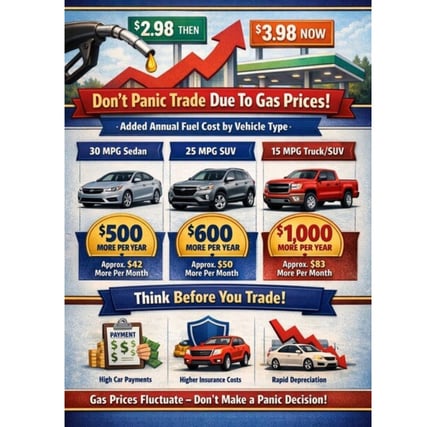
Let’s start with a vehicle getting 30 miles per gallon. Over 15,000 miles, you’ll burn about 500 gallons of fuel per year. At $2.98 per gallon, that cost you $1,490 annually. At $3.98, you’re now spending $1,990. That’s a difference of $500 per year, or about $41.67 per month.
Now let’s look at 25 miles per gallon, which is pretty typical for a lot of midsize SUVs. You’ll use about 600 gallons per year. At $2.98, that’s $1,788 annually. At $3.98, it jumps to $2,388. That’s a $600 increase per year, or $50 per month.
Now for the big trucks and full-size SUVs, let’s say 15 miles per gallon. You’re using about 1,000 gallons annually. At $2.98, your yearly fuel cost was $2,980. At $3.98, it rises to $3,980. That’s a $1,000 increase per year, or about $83.33 per month.
So yes, it costs more. No argument there. But now let’s talk about what people are doing in response—and why it usually doesn’t make financial sense.
I’ve seen folks trade in a perfectly good truck or SUV they like, often one that fits their lifestyle, towing needs, or family size, just to chase better fuel economy. The problem is, that move typically comes with a much larger financial hit than the increase at the pump.
Let’s say you trade your truck and take on a new car payment that’s $150 to $300 more per month. Or maybe you’re rolling negative equity into a new loan, stretching payments out longer, or paying higher insurance because the replacement vehicle is newer. Suddenly, you’re spending thousands more per year just to save a few hundred in fuel.
Even in the worst-case example we just ran—a 15 MPG vehicle—the increase is about $83 a month. That’s real money, but it’s still often less than the financial impact of making a bad trade decision in a hurry.
Remember also that when gas prices go up, large vehicle values drop, and fuel-efficient vehicle prices go up. Sixty days from now when gas is back under $3 per gallon, are you going to want your bigger vehicle back? Odds are you won’t be able to trade back and it will have cost you thousands of dollars.
There’s also the reality that gas prices are cyclical. We’ve seen this movie before. Prices go up, people panic, then prices settle back down. If you make a long-term financial decision based on a short-term spike, you’re locking in a cost that doesn’t go away when gas prices eventually come back to earth. My personal belief is the Iran conflict will be over very soon and gas prices will plummet.
Another factor people overlook is depreciation. The moment you trade your vehicle, you’re resetting the depreciation curve. That “fuel-efficient” car you just bought is going to lose value faster in the early years than the vehicle you already own. That hidden cost alone can easily outweigh what you’re saving at the pump.
And let’s not forget practicality. If you need a truck for work, towing, or hauling, downsizing can create new headaches—and sometimes new expenses—when you have to rent a truck or pay someone else to do what your vehicle used to handle.
None of this is to say fuel economy doesn’t matter. It absolutely does, especially if you’re already in the market for a vehicle. In that case, it makes perfect sense to factor in MPG and consider hybrids or more efficient options. But making a knee-jerk decision solely because gas jumped a dollar a gallon is where people get into trouble.
Here’s the bottom line: a spike in gas prices feels dramatic, but when you break it down, the actual monthly impact is usually manageable. Trading vehicles, on the other hand, is almost always a much bigger financial commitment with longer-lasting consequences.
So, before you rush out to trade that truck or SUV, take a breath, run the numbers, and make sure you’re solving the right problem. Because more often than not, the smartest move is the one where you keep what you’ve got and ride it out.

.jpg?width=150&name=jerry-headshot.jpg%20(1).jpg)