
If you've listened to my radio show for any length of time, you already know this: I don't put much stock in Consumer Reports when it comes to automobiles.
That isn't a new opinion. I've been saying it for years.
I've been in the automobile business for many decades. I've owned dealerships, bought and sold thousands of vehicles, reviewed new vehicles every week for 25 years, and talked to hundreds of thousands of listeners about their ownership experiences. During all that time, Consumer Reports has consistently been one of the last places I look when evaluating a vehicle.
That's not because I think everything they publish is wrong. It's because I've watched them repeatedly take a small piece of information, strip away the context, and turn it into a scary headline that leaves consumers with a distorted view of reality.
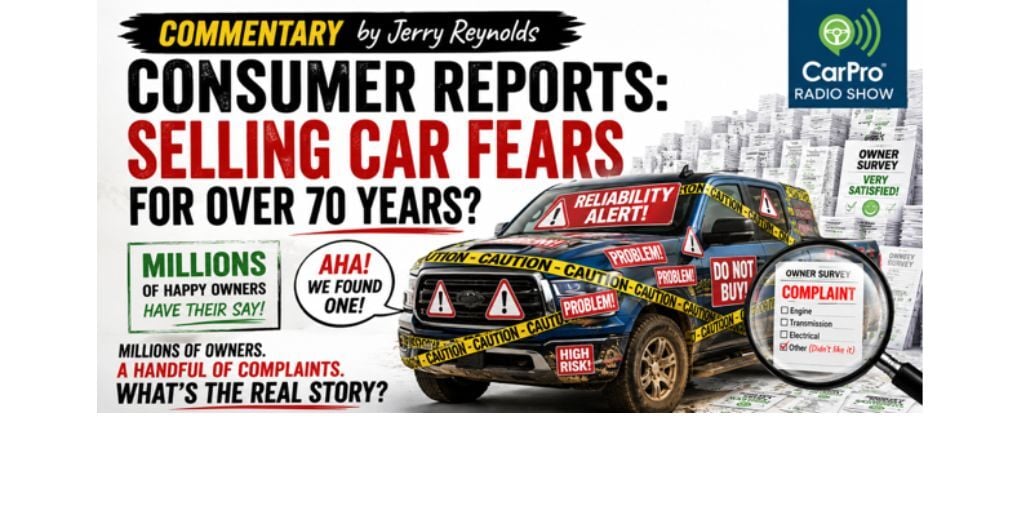
Sometimes I think Consumer Reports could survey ten million happy owners, find twenty people with complaints, and somehow the twenty would end up in the headline.
In fact, if Consumer Reports had been around in the days of the anvil, they probably would have found a way to rate it below average for durability.
That may sound harsh, but after decades of watching their vehicle rankings, reliability studies, and annual "vehicles to avoid" lists, I've come to believe Consumer Reports often focuses on the most alarming interpretation of the data while paying far less attention to the bigger picture. Sex sells, but so do shocking headlines.
Their latest pickup truck reliability rankings are a perfect example.
According to Consumer Reports, several full-size pickups, including the Ram 1500 and Toyota Tundra, rank among the least reliable vehicles on the market. If you only read the headline, you might reasonably conclude these trucks are disasters waiting to happen and that smart consumers should stay far away from them.
The problem is that headlines rarely tell the whole story, and when it comes to pickup trucks, the whole story matters a lot more than a survey.
Let's start with the Toyota Tundra.
For decades, the Tundra has enjoyed one of the most remarkable reliability reputations in the automotive industry. Toyota didn't earn that reputation through advertising campaigns or clever marketing slogans. It earned it one truck at a time, one owner at a time, and one mile at a time.
The stories became legendary. Owners routinely drove them 300,000, 400,000, and even 500,000 miles. Contractors depended on them. Ranchers depended on them. Small-business owners depended on them. If there was ever a truck that built its reputation the old-fashioned way, through years of dependable service in the real world, it was the Toyota Tundra.
Then Toyota launched a new generation and experienced highly publicized engine problems. It happened. Toyota acknowledged it, took responsibility, and took corrective action. As I predicted on the air, Toyota is replacing engines instead of fixing them even though it will cost a lot more. Why? The customer gets their truck back much quicker and there is less chance of something going wrong.
But here's the question Consumer Reports never seems particularly interested in asking: Does one problematic model year erase decades of extraordinary performance?
Of course not.
A truck's reputation should be built over decades, not destroyed in a single survey cycle.
If a Hall of Fame pitcher has a bad season, nobody forgets the previous fifteen years. If a restaurant serves one disappointing meal after twenty years of excellence, nobody suddenly decides the restaurant was never any good.
Yet that often seems to be how automotive rankings work Consumer Reports.
One bad chapter suddenly becomes the entire book.
The same problem exists when evaluating pickup trucks in general.
Pickup trucks are America's best-selling vehicles year after year. Millions of them are on the road doing real work every day. They tow equipment, haul materials, pull boats, transport families, work farms, navigate construction sites, and endure conditions that most passenger vehicles will never experience.
When millions of vehicles are being used that hard, there are naturally going to be more reported problems.
What I rarely see from Consumer Reports is any meaningful discussion of that reality. They don’t take the time to ask the questions that should be among the basic principles of journalism:
- Were the trucks maintained properly?
- Were they towing within their rated capacities?
- Were they modified?
- Were they used commercially?
- How many miles were on them when the problems occurred?
Those details matter, yet they often disappear once the headline has been written.
Another issue I have with many reliability rankings is that they frequently fail to distinguish between different types of problems.
A frozen infotainment screen may count as a reliability complaint. A software update issue may count as a reliability complaint. A backup camera glitch may count as a reliability complaint. An engine failure may count as a reliability complaint.
Most consumers would agree those problems are not remotely equal.
If my touchscreen freezes once and reboots itself, that's an inconvenience. If my engine self-destructs on the interstate, that's a catastrophe. Yet many surveys lump those issues together into a single reliability score, creating a ranking that may sound alarming but doesn't necessarily reflect the actual ownership experience.
The example that really caught my attention was the Ram 1500.
Consumer Reports recently placed the Ram near the bottom of its reliability rankings, creating the strong impression that buyers should be concerned. Yet at roughly the same time, J.D. Power ranked the Ram 1500 highest among large light-duty pickups in its Vehicle Dependability Study. So one respected organization was effectively warning consumers away from the truck while another was recognizing it as the segment leader in long-term dependability.
Think about that for a moment.
The same truck was being portrayed by one organization as a reliability loser while another organization was recognizing it as the most dependable truck in its class.
Both organizations claim to be helping consumers.
Both organizations claim to be using data.
Yet they reached completely different conclusions about the exact same vehicle.
That should tell consumers something important.
These rankings are not facts. They are interpretations. Also bear in mind, J.D. Power doesn’t sell anything like subscriptions. They are known as the gold standard when it comes to research. So, which one of the two organizations are you going to believe? The problem is many Consumer Reports readers may not see the Power study and make a bad car buying decision.
Different organizations survey different owners, measure different things, weigh different problems differently, and arrive at different conclusions. When one study says a truck is among the worst and another says it's among the best, the lesson isn't that the truck magically changed overnight. The lesson is that consumers should never treat any single ranking as gospel.
This isn't the first time Consumer Reports has found itself at the center of controversy, either.
Many longtime automotive enthusiasts still remember the Isuzu Trooper dispute from the mid-1990s. Consumer Reports gave the Trooper a highly publicized "Not Acceptable" rating after a handling test suggested rollover concerns. Isuzu strongly challenged the findings, arguing that the testing did not reflect real-world driving conditions, and the disagreement eventually ended up in court.
The point isn't whether Consumer Reports ultimately won or lost the argument.
The point is that the episode demonstrated something I've believed for a very long time: Consumer Reports is not infallible and when it comes to cars, not credible.
Its conclusions are based on testing methods, assumptions, predictions, interpretations, and judgments that can be questioned and debated.
The Isuzu Trooper wasn't the first time Consumer Reports found itself in controversy. The publication's handling of the Suzuki Samurai generated years of litigation after Suzuki alleged that Consumer Reports altered its testing procedures until it achieved the rollover result it was seeking. During the lawsuit, Suzuki pointed to internal communications and testimony that it argued suggested testers were determined to produce a rollover result, including allegations that a Consumer Reports employee remarked, "If you can't find someone who can flip this car, I will."
Consumer Reports denied Suzuki's allegations and stood by its testing, but the episode remains one of the most controversial chapters in automotive testing history. Whether you side with Suzuki or Consumer Reports, the lesson is the same: testing methodologies matter, and they deserve scrutiny.
That's important because many consumers treat Consumer Reports ratings as if they were carved into stone tablets and delivered from the mountaintop.
They're not.
They are opinions based on their data. And they make their money selling subscriptions.
After more than forty years in this business, I've learned that vehicles earn reputations over years and decades, not survey cycles.
Ford didn't become America's best-selling truck for nearly half a century because of one survey. Toyota didn't build its reputation because of one survey. Chevrolet, GMC, and Ram didn't develop massive owner loyalty because of one survey.
They earned those reputations through millions of owners using their vehicles in the real world, year after year, mile after mile.
That's not to say manufacturers should get a free pass when they make mistakes. They shouldn't. When an automaker builds a defective engine, transmission, or electronic system, they deserve criticism. Consumers deserve transparency, accountability, and solutions. I will lead the bandwagon when it’s needed and when my listeners need to know something about a vehicle problem.
What consumers don't deserve is fear masquerading as perspective and truth.
They deserve to know the difference between a temporary problem and a long-term pattern. They deserve to know the difference between a software annoyance and a catastrophic mechanical failure. They deserve to understand a vehicle's history instead of being encouraged to focus solely on the latest alarming headline.
What concerns me about Consumer Reports isn't that they publish reliability rankings.
It's that too often those rankings appear designed to generate concern rather than understanding.
A single survey becomes a sweeping judgment.
A temporary issue overshadows decades of proven performance.
A handful of complaints create the impression that an entire vehicle line is somehow flawed.
That may sell magazines, subscriptions, and clicks. It doesn't necessarily help consumers make better decisions.
The next time you see a Consumer Reports list of the "worst" vehicles on the road, do yourself a favor. Read beyond the headline. Look at the methodology. Consider the vehicle's history. Talk to actual owners. Review multiple sources. Think critically about what you're reading. Hell, ASK ME. I arguably talk to more automotive consumers than anybody in America. I don’t sell subscriptions to my weekly publication, and I sure don’t need to scare you. Do what I do: Be immediately suspect when you see something from Consumer Reports about cars. If you need a recommendation on a toaster, a washer/dryer, or any appliance, they may be great, I can only speak to what I know: Cars.
Because when you're spending sixty, seventy, or eighty thousand dollars on a new truck, you deserve the complete story, not just the scariest part of it.
.jpg?width=150&name=jerry-headshot.jpg%20(1).jpg)