
Snitches get stitches. Nobody likes a tattletale. Mind your own business. Everybody hates a rat. Maybe it’s time we rethink that.
There’s a question floating around the auto industry right now that would’ve sounded unthinkable just a few years ago: Will car dealers start turning each other in for deceptive advertising practices?
If you listen to the Federal Trade Commission, the answer is: they hope so.
At a webinar hosted by the National Automobile Dealers Association, FTC Bureau of Consumer Protection Director Christopher Mufarrige made it clear. If you’re a dealer playing by the rules and the guy down the street isn’t, go ahead and report him. File it on the FTC’s website. Help level the playing field.
And you know what? I’m all for it.
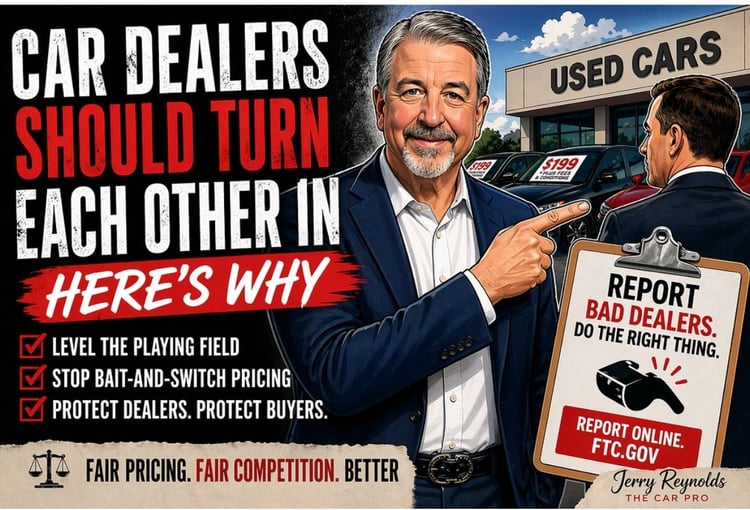
Let’s not pretend this is some shocking betrayal of dealer brotherhood. That “brotherhood” tends to disappear the moment one store starts advertising a price that’s thousands below everyone else—only for customers to find out later it was loaded with fine print, add-ons, or fees that magically appear when they walk in the door.
That’s not competition. That’s deception, and it happens every single day.
The FTC has been trying to clean this up for years. In March, it sent warning letters to 97 dealership groups over potential advertising violations. Now, it’s doubling down on what it calls “total advertised price”—the number a customer sees should be the number they can realistically pay to drive the car home, minus legitimate government fees.
Seems simple, right? It should be.
But as anyone who has spent time in this business knows, it’s not. Dealers have gotten creative—some would say too creative—with conditional rebates, required add-ons, and pricing that depends on qualifiers buried deeper than a Texas oil well.
FTC Chairman Andrew Ferguson summed it up well during that same webinar: consumers are frustrated when the price they see advertised isn’t the price they get on the showroom floor.
That frustration doesn’t just hurt buyers. It hurts honest dealers.
If you’re a dealer who prices vehicles transparently, includes everything upfront, and avoids bait-and-switch tactics, you’re at a disadvantage when a competitor is advertising a fantasy price just to get the phone to ring. That traffic gets diverted away from you before the customer ever has a chance to see how you actually do business.
That’s the real damage here.
So, when the FTC suggests that dealers report bad actors, I don’t see it as “ratting each other out.” I see it as self-preservation. It’s self-defense. And it’s the right thing to do.
Because let’s be honest about something else: the FTC and state regulators haven’t exactly been lighting the world on fire with enforcement. They’ve got limited resources, a massive industry to oversee, and an endless stream of complaints. They can send warning letters—and they have—but policing every misleading ad across websites, social media, radio, and TV? That’s a tall order.
Even the FTC acknowledges the complexity. During the webinar, officials discussed how dealers don’t always control every piece of advertising content, especially when it comes from third-party marketplaces or OEM partners. That’s fair. But it also creates gray areas that bad actors are more than happy to exploit.
Which brings us back to the idea of self-policing.
Who knows better than a dealer when another dealer is playing games? Who sees the ads, hears the claims, and understands exactly where the line is being crossed?
Other dealers. So this is what is making bad dealer’s sweat: It is no longer the slight fear of being caught by a government agency-they’ll have every competitor looking over their ads, itching for some reason to turn them in. That is a strong motivation to have transparent pricing or face the consequences.
If the industry wants credibility—and believe me, it needs it—then this is one way to start rebuilding it. Not with more rules, but with better accountability.
Will every dealer jump on board? Of course not. Some will keep pushing the envelope as far as they think they can get away with. Some will set up reserve accounts to save up money in advance to pay the fines, and they’ll charge it to advertising expense. Just a cost of doing business. Others will hesitate to report competitors for fear of retaliation or just out of habit.
But I suspect something will change.
Because the dealers who are doing it right are tired of losing deals to smoke-and-mirror pricing. They’re tired of explaining why their price is higher when, in reality, it’s just more honest.
And now, for the first time in a while, they’ve been given permission—maybe even encouragement—to do something about it.
If that means a few bad apples get called out along the way, so be it.
In the long run, that’s not bad for dealers.
And it’s definitely not bad for car buyers. We’ll also find out who the real salespeople are in this industry. I started the Car Pro Show to call out the bad dealers and to protect consumers from them. If dealers jump on board, I may put myself out of a job. If so, I’ll go fishing. Hell, I might even catch something.
.jpg?width=150&name=jerry-headshot.jpg%20(1).jpg)