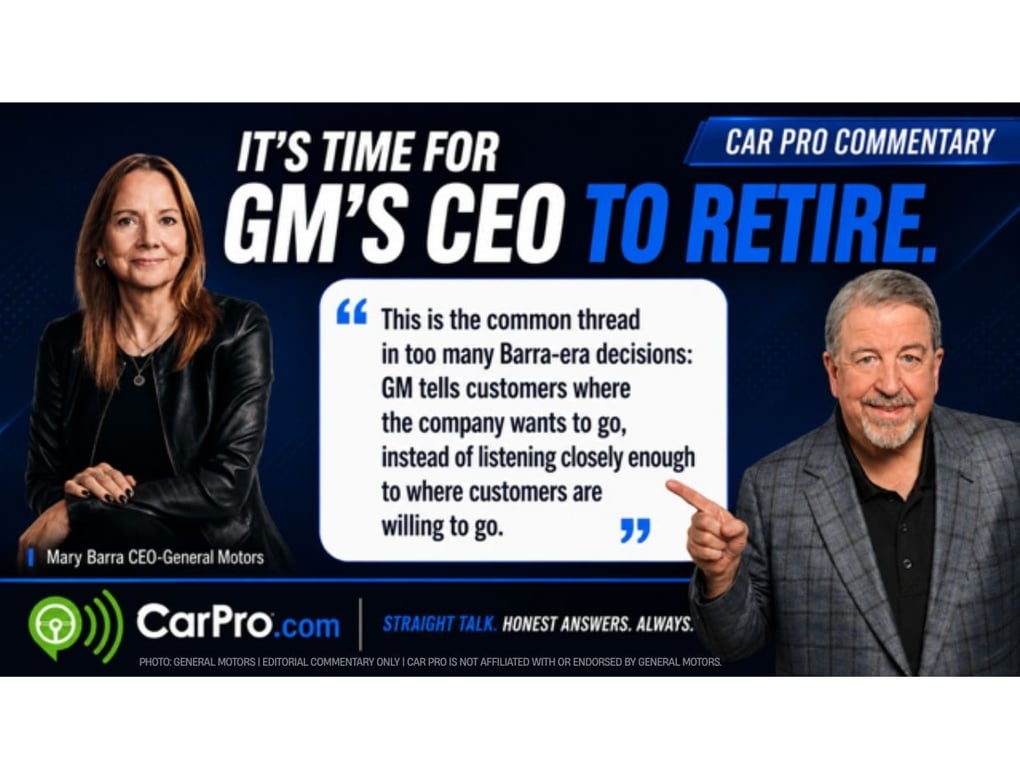

I want to start this commentary with something important: this is not personal. I have no reason to believe Mary Barra is anything other than smart, capable, gracious, and a very nice person. This also has nothing to do with her being a woman. That argument is nonsense, and frankly, it always has been.
My concern with Mary Barra goes all the way back to when she got the top job at General Motors in 2014. I did not think she was the right person for that job then, and after watching the decisions GM has made over the past dozen years, I am more convinced of it now.
GM’s own filings show an impressive career, but they also show exactly what concerned me. Before becoming CEO, Barra’s background was largely in product development, purchasing, supply chain, human resources, and manufacturing engineering. She became GM CEO in January of 2014 and later became chair in January of 2016. What I do not see in that résumé is meaningful experience on the sales side, the dealer side, or the retail battlefield where GM either wins or loses one customer at a time.
That matters. General Motors is not just an engineering company. It is not just a technology company. It is not a political science project. It is a company that has to build vehicles real people want, price them correctly, support dealers, keep owners happy, and make sure the product holds together after the press release fades. At the end of the day, customers do not buy strategy decks. They buy cars and trucks.
To be fair, GM is not some company gasping for air on the side of the road. It remains a giant. GM’s 2025 annual report said the company sold 2.85 million vehicles in the United States in 2025 and increased its U.S. market share to 17.2%, up from 16.5% in 2024 and 16.2% in 2023. The same annual report showed GM was still profitable, with 2025 net income attributable to stockholders of $2.7 billion and adjusted EBIT of $12.7 billion. That is a far cry from the company that begged Congress for money in 2008.
So no, this is not me saying Mary Barra has done nothing right. That would not be fair, and it would not be accurate. GM still sells a lot of vehicles, especially trucks and SUVs, and the company has certainly had some strong financial moments during her tenure.
But my question is not whether Mary Barra has had any successes. My question is whether she is the right person to lead General Motors into the future. My answer is no.
There is also the matter of compensation. I do not begrudge anyone making a lot of money if the performance is there, especially when we are talking about one of the largest automakers in the world. Still, the numbers around Barra’s pay are staggering. Using GM proxy figures and published compensation reports, her CEO-era compensation is roughly a $300 million run. GM’s 2016 proxy listed her total compensation at $16.2 million for 2014 and $28.6 million for 2015. Reuters reported her 2020 compensation at $23.7 million. GM’s 2026 proxy listed her total compensation at $29.1 million for 2021, $29.0 million for 2022, $27.8 million for 2023, $29.5 million for 2024, and $29.9 million for 2025.
GM’s 2026 proxy also listed Barra’s 2025 pay ratio at 333-to-1 compared with GM’s median employee compensation of $89,785. Again, I am not saying a CEO of General Motors should be paid like a greeter at the local Wal-Mart, but when someone has been paid at that level for that long, it is fair to ask whether the company has received that much clear vision, product discipline, customer focus, and long-term strategic success. In my opinion, the answer is no.
The biggest problem, in my opinion, is that GM under Barra has too often chased the future it wanted instead of reading the market it actually had. Read that sentence again. The best example is electric vehicles.
GM charged hard into EVs, and every major automaker had to invest in electric vehicles to some degree. That part is not the issue. The issue is how hard GM leaned into an all-electric future while real customers were still sending a very different message.
GM’s own 2025 annual report says changes in public policy, including the termination of certain consumer tax incentives (the $7,500 federal rebate) and reduced emissions requirements, contributed to slower EV demand in North America. GM reassessed its EV capacity and manufacturing footprint and recorded $7.9 billion in GM North America charges in 2025 tied to EV strategic realignment and cancellation costs. To be precise, those charges are not the same thing as a clean line-item “EV operating loss,” but they are very real costs from a strategy being resized after reality failed to match the original plan.
The problem is not that GM invested in electric vehicles. The problem is that GM appeared to go “all-in” while the market was still saying, “Let’s slow down and talk about this.” Toyota, on the other hand, kept looking at real customers and real driving habits, and it leaned heavily into hybrids.
Honda did, too.
That is important, because Toyota is not the only hybrid success story. Toyota is the king of hybrids, and I still believe Toyota builds the best hybrids in the business, but Honda has also proven the point. American Honda reported 2025 U.S. sales of 1,430,577 vehicles, its best year since 2021, and said Honda-brand electrified models exceeded 400,000 units. Honda also said hybrids represented 54% of CR-V sales in 2025. In the first quarter of 2026, Honda said the CR-V Hybrid represented 56% of the CR-V model mix. Last month, the Honda CR-V outsold every vehicle in America including F-Series trucks, Silverado, and the Toyota RAV4.
This is where we need to slow down and define a word the auto industry loves to throw around: “electrified.” To people off the street, electrified sounds like all-electric. It is not. Electrified usually means a mix of regular hybrids, plug-in hybrids, battery-electric vehicles, and sometimes even fuel-cell vehicles. So, when Toyota said it sold 1,183,248 electrified vehicles in the U.S. in 2025 and that electrified vehicles represented 47% of its total U.S. sales, that does not mean Toyota sold over a million pure EVs. It did not. That number was driven heavily by hybrids across Toyota and Lexus. Toyota also said it had 30 electrified vehicle options across the two brands, which again includes more than just EVs.
That distinction matters because GM’s mistake was not simply missing the EV market. GM’s bigger mistake was missing the customer’s middle ground. Reuters reported that U.S. hybrid sales were up 19% in the first half of 2026, while GM, which does not sell hybrids in the U.S., saw battery-electric sales fall 33%. Let that sink in.
That is the point. Toyota and Honda did not wait for every customer to become an EV customer. They gave buyers a bridge. GM, under Barra, spent years talking about an all-electric future while millions of actual buyers were saying: “I’d like better fuel economy, but I don’t want to plug in.” Toyota heard them. Honda heard them. Albeit late, Hyundai and Kia heard them. GM apparently had the radio turned off.
Then there is the Chevrolet Malibu. I wrote about it when it was given the death sentence.
GM decided to end Malibu production in 2024, and the Kansas City plant was slated to be retooled for the next-generation Chevrolet Bolt. According to the Associated Press, Americans bought about 1.3 million midsize cars in 2023, and GM sold just over 130,000 Malibus that year. The Malibu was also the last mainstream Chevrolet car after the Camaro went away, other than the Corvette, which lives in a very different neighborhood.
In 2024, the Malibu reportedly still sold more than 117,000 units. I understand sedans are not what they once were. I understand margins are better on trucks, SUVs, and crossovers. I understand the industry has changed. But 117,000 sales is not nothing. There are automakers that would throw a parade for 117,000 sales. GM threw the Malibu a retirement party.
The Malibu was not a perfect car, but it served a purpose. It gave Chevrolet a real passenger car for people who did not want an SUV, could not afford a truck, or simply liked the way a sedan drives. Killing it left Chevrolet almost completely out of the traditional car business. That may look good on a spreadsheet today, but it sends a message: if you do not want a crossover, truck, Corvette, or EV, Chevrolet may not be thinking much about you anymore. How many Malibu owners today are driving a Camry, an Accord, or a Sonata? Will the Chevy dealers ever see those people in their showroom again?
That brings me to vision. I do not see a clear one.
GM’s old slogan under Barra was “zero crashes, zero emissions, zero congestion.” It sounded bold, but today it looks like three slogans in a trench coat. Cruise, GM’s self-driving robotaxi business, is no longer being funded as a robotaxi operation. EVs have been realigned after massive charges. Hybrids were ignored while Toyota and Honda were proving the business case. Cars have mostly been abandoned. Trucks remain the profit engine, but GM has had serious quality issues in the very engines and transmissions that truck buyers depend on most.
The 6.2-liter V8 issue is not Internet gossip. In April 2025, GM recalled nearly 600,000 vehicles equipped with the 6.2-liter L87 V8, including certain Cadillac Escalade, Chevrolet Silverado 1500, Chevrolet Suburban, Chevrolet Tahoe, GMC Sierra 1500, GMC Yukon, and GMC Yukon XL models. GM told NHTSA the issue involved potential connecting rod and/or crankshaft defects that could lead to engine damage or engine failure. GM’s filing also said its investigation identified 28,102 field complaints or incidents potentially related to L87 engine failure, including 14,332 involving loss of propulsion, along with 12 potentially related crashes or injuries and 42 fire allegations.
When your full-size trucks and SUVs are the heart of your profits, engines are not just another component. They are the steak. Everything else is garnish.
The 5.3-liter V8 has had its own reputation problems, especially around lifter and valve-train complaints tied to GM’s cylinder-deactivation systems. Some of those issues have been the subject of litigation alleging defects in GM’s AFM and DFM valve-train systems. To be clear, allegations in lawsuits are not the same as proven defects, and GM has fought these claims, but customers do not talk in legal disclaimers when their truck is in the shop. They talk to neighbors, friends, service advisors, and radio guys like me.
GM has also been fighting transmission litigation for years, especially involving complaints about shuddering, slipping, jerking, harsh shifts, and delayed engagement in certain 8-speed transmissions. Reuters reported in 2024 that GM was ordered to face a class action involving more than 800,000 Cadillac, Chevrolet, and GMC vehicles from model years 2015 through 2019 equipped with 8L45 or 8L90 transmissions. In 2025, Reuters reported that GM won decertification of that class action in a divided appeals court ruling, sending the litigation back for further proceedings. That procedural victory matters legally, but the broader customer-confidence issue did not just vanish.
Then there was the Chevrolet Bolt battery fire mess. NHTSA said in August 2021 that all Chevrolet Bolt EVs were being recalled because the high-voltage battery packs could catch fire, including vehicles that had already received an earlier recall repair. Supplier issues matter, and battery manufacturing issues are complicated, but the badge on the car said Chevrolet. Customers do not pull into the driveway and say, “Honey, the LG battery pack is home.” They say, “That’s my Chevy.”
Cruise may be the biggest symbol of GM’s strategic overreach.
Reuters reported that GM had invested more than $10 billion in Cruise before deciding in December 2024 to stop funding its robotaxi development. Reuters also reported that Barra had once projected Cruise could generate $50 billion in annual revenue by 2030. GM’s own announcement said it would no longer fund Cruise’s robotaxi work because of the considerable time and resources needed to scale the business and the increasingly competitive robotaxi market.
That is not a small miss. That is a moonshot that came back through the roof.
To GM’s credit, ending the robotaxi spending may have been the right decision. But the better question is why it took that long, and why so much money was spent chasing a business that never came close to matching the hype.
Then we have one of the most baffling customer-facing decisions of all: dropping Apple CarPlay and Android Auto.
In 2023, Reuters reported that GM would phase out Apple CarPlay and Android Auto in future EVs, replacing them with built-in infotainment software developed with Google. In 2025, The Verge reported that GM planned to extend that phaseout beyond EVs to future gas-powered vehicles as well.
This is where the lack of retail instinct really shows. People love Apple CarPlay and Android Auto. They understand them. They use them every day. They trust their phones more than they trust most factory infotainment systems, and frankly, history says they should.
A McKinsey survey found that almost half of car buyers globally would not buy a vehicle that lacked Apple CarPlay or Android Auto, and that 85% of those who used the systems preferred them over the automaker’s built-in system.
So, GM’s answer is to take away something customers like, use, and understand, then ask them to trust GM software instead? That is like a restaurant taking coffee off the menu because it invested heavily in a new tea strategy.
I understand why GM wants control over the software environment. Automakers want data, subscriptions, and recurring revenue. I get it. Wall Street likes that story. But customers are not revenue streams with seatbelts. They are people who paid a lot of money for a vehicle, and they do not want an automaker making their daily life harder in the name of “integration.”
This is the common thread in too many Barra-era decisions: GM tells customers where the company wants to go, instead of listening closely enough to where customers are willing to go.
EVs? Customers said not so fast.
Hybrids? Customers said yes, but GM said no.
Cars? Some customers still wanted them, but GM walked away.
Cruise? The future was promised, then the spending stopped.
CarPlay and Android Auto? Customers love them, but GM decided it knows better.
Truck engines and transmissions? Customers expect durability first, last, and always, but too many owners have had reasons to question it.
That is why I believe it is time for Mary Barra to retire.
Not in disgrace. Not with pitchforks. Not with people pretending the company never made money under her leadership. But with a clear-eyed recognition that GM needs a different kind of leader now.
GM needs someone who understands product, but also understands dealerships. Someone who knows that a dealer service lane can tell you more truth in one morning than a consultant can tell you in six months. Someone who respects EVs but does not worship them. Someone who sees hybrids not as a compromise, but as exactly what millions of people want right now. Someone who understands that full-size truck quality is sacred. Someone humble enough to admit that Apple and Google are better at phone integration than GM is. Someone who knows that customers are not being difficult when they reject a bad idea; they are doing the company a favor.
General Motors has great brands. Chevrolet still means something. GMC still means something. Cadillac still has the power to be great. Buick, against the odds, has found new energy with younger buyers. GM dealers are some of the toughest and best operators in the business. The company has the talent, the scale, and the history to do much better than simply chasing whatever the next boardroom buzzword happens to be.
But it needs a clearer direction. It needs fewer moonshots and more common sense. It needs fewer lectures about the future and more listening to the people who actually buy the vehicles. It needs to stop acting like customers are slow to understand GM’s brilliance and start asking whether GM has been slow to understand its customers.
Mary Barra has been CEO since 2014. That is a long run. In car terms, that is not a lease; that is two redesign cycles, three sets of tires, and at least one infotainment system that probably needs an update.
She has had her opportunity. She has had her victories. She has also had enough major strategic misses that it is fair to ask whether GM would be better served by new leadership.
My answer is yes.
It is time for Mary Barra to retire, thank her for her service, and let General Motors find a leader with a clearer vision, a stronger feel for the retail customer, and the courage to admit that the future of the auto business will not be built by ignoring what buyers are telling you today.
A note from the Car Pro, Jerry Reynolds: I spent over a month researching the facts and conclusions I came to with every spare moment I had. This started out as a question: Is it time for Mary Barra to Retire? The more I dug, the more this turned into It’s Time for Mary Barra to Retire. I don’t take this lightly, and I hope this was balanced to point out the good decisions the GM CEO made, and there were many. Before anyone asks or comments, yes, I am now starting similar research about Jim Farley, the Ford CEO. I have no idea where that will take me, but as soon as I am done and satisfied, I will bring that to you with my conclusions. In my heart, I want every automaker to be successful. This industry is the one that will lead America as we cruise toward 300 years of success building vehicles people want to drive. American entrepreneurs started it, and they should be the best in world at building them.

.jpg?width=150&name=jerry-headshot.jpg%20(1).jpg)