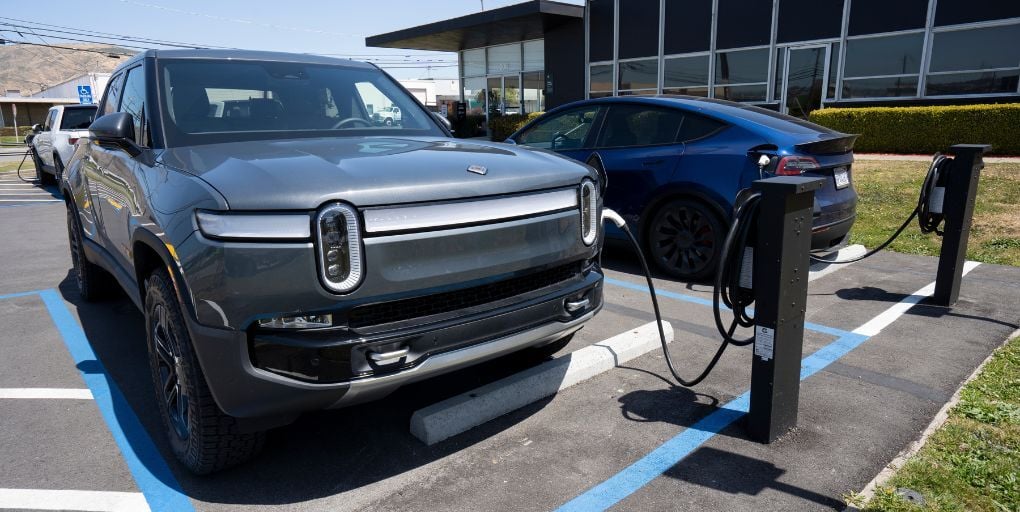

California will not provide replacement incentives for electric vehicle buyers after the federal government’s $7,500 tax credit expired Sept. 30, Gov. Gavin Newsom said, reversing an earlier pledge that the state would step in with its own subsidies.
The announcement is a setback for automakers that had pressed Sacramento to cushion the impact of the expiring federal program. Companies including Tesla, Rivian, Hyundai, and Volkswagen had urged the state to create a $5,000 incentive that could help keep sales momentum in the nation’s largest EV market. The federal tax credit has been a cornerstone of EV adoption in the United States for more than a decade, helping manufacturers offset the higher upfront costs of battery-powered models.
President Donald Trump campaigned on rolling back many of former President Joe Biden’s climate and electric vehicle policies. Congress followed suit earlier this year with a broad tax-and-spending bill that set Sept. 30 as the sunset date for the EV tax credit. That legislation ended years of direct federal financial support for consumers who opted for electric vehicles.
Newsom last year pledged that California would act if the federal incentive was eliminated. At the time, the governor said EV adoption was too important to the state’s climate agenda to risk losing ground. But California’s budget picture has since darkened, with a multibillion-dollar deficit prompting cuts across a wide range of programs. In that environment, state leaders concluded they could not replace the federal benefit.
“We can’t make up for federal vandalism of those tax credits,” Newsom said Sept. 19 during a press conference in San Francisco. He added that the state will continue to invest in EV infrastructure, such as charging networks, but “not the direct subsidies that we cannot make up for.”
The governor also directed sharp criticism at Detroit’s automakers, singling out General Motors and its CEO Mary Barra. He accused GM of siding with Trump during earlier regulatory battles over emissions and said California was left carrying the burden. “They sold us out,” Newsom said.
Newsom’s comments followed a congressional vote earlier this year to block California’s ban on the sale of new gasoline-powered vehicles scheduled to take effect in 2035. The governor argued that GM led the effort to stop that rule, which the state projected in 2020 would reduce greenhouse gas emissions by more than 35 percent. GM declined to comment.
The loss of the federal incentive comes at a delicate time for the EV market. Sales growth has slowed after several years of rapid expansion, and consumers are showing increased price sensitivity as higher borrowing costs weigh on household budgets. The $7,500 credit often made the difference between an EV being cost competitive with a gasoline-powered vehicle or not.
Automakers have invested billions of dollars to bring new electric models to market, and many had counted on steady government support to help bridge the transition period. Tesla, Rivian, and other startups face particular pressure, while global players such as Hyundai and Volkswagen see California as a critical market for their electrification strategies. Without federal or state subsidies, companies may be forced to offer bigger discounts or delay product plans.
Industry analysts note that California has long been a leader in EV adoption, representing a large share of U.S. sales thanks to aggressive emissions standards and a supportive policy environment. But even here, incentives have played a major role. Programs like the federal tax credit and the state’s earlier Clean Vehicle Rebate Project helped spur demand among mainstream buyers. Removing both could slow adoption at a time when California is pushing to end sales of new gasoline-only cars by 2035.
The governor’s office said California could still revive an EV credit next year, as state leaders consider allocating hundreds of millions of dollars from a carbon-trading program that funds environmental initiatives. The California Air Resources Board and five other state agencies in August recommended using available resources to replace the federal incentive.
California’s previous EV rebate program ended in 2023, leaving it outside of the 17 states that currently offer some form of EV purchase credit, according to an August report from the Tax Foundation. Even so, California still accounted for about 27 percent of all EV sales in the country, according to the Alliance for Automotive Innovation, which represents most major automakers. That dominance had positioned the state as the best candidate to backfill the federal credit.
For now, the near-term effect is straightforward. The $7,500 federal tax credit are no longer available on new EV purchases, and California will not step in with its own rebate. Buyers weighing whether to make the switch to electric vehicles may find fewer financial reasons to do so, even as charging availability improves.
.jpg?width=150&name=jerry-headshot.jpg%20(1).jpg)



.jpg?width=2040&name=vw-id4-charging-volta-amy%2520(1).jpg)