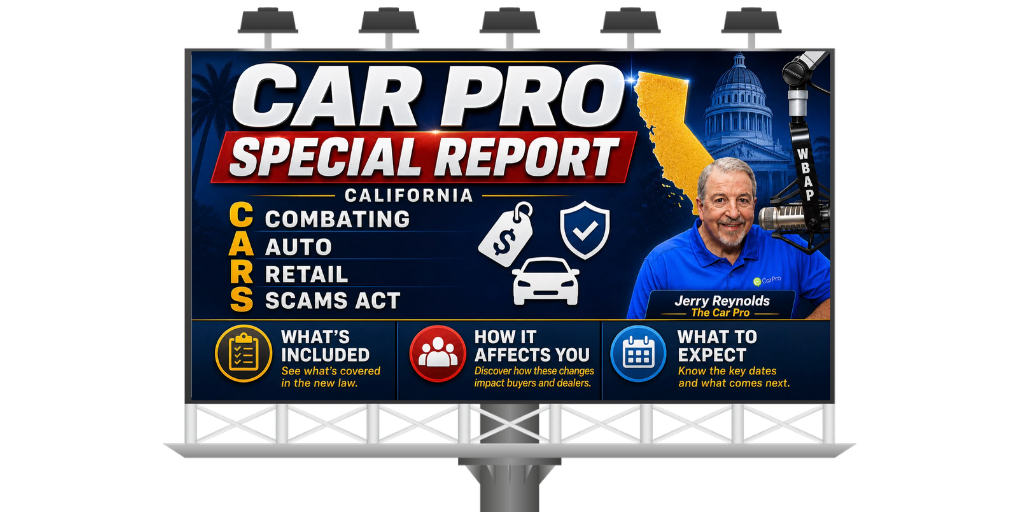

Listeners to the Car Pro Show and readers of my newsletter have heard me talk repeatedly about the Federal Trade Commission cracking down on car dealers over misleading advertisements, hidden mandatory fees, unavailable rebates, unwanted add-ons and prices that mysteriously increase after a customer reaches the dealership. I have also said many times that dishonest advertising hurts more than car buyers. It puts honest dealers at a competitive disadvantage because the dealer advertising a real price can appear more expensive than the dealer advertising a price that nobody can actually pay.
The FTC tried to address those problems nationwide through its Combating Auto Retail Scams Rule, better known as the CARS Rule. That federal rule never took effect, but California has now taken many of the same ideas, placed them into state law and added a major protection that was not part of the FTC proposal: an automatic three-day right to cancel many used-car purchases and leases.
California Senate Bill 766, the California Combating Auto Retail Scams Act, was signed by Gov. Gavin Newsom on Oct. 6, 2025. The law becomes operative Oct. 1, 2026. It applies primarily to retail vehicle sales, leases and financing transactions conducted by licensed California dealers.
The California New Car Dealers Association calls it the most significant change to the state’s vehicle sales process since the California Car Buyer’s Bill of Rights was enacted in 2005. That is not an exaggeration. The new law reaches dealership advertising, internet leads, price quotes, monthly-payment discussions, Finance Department products, used-car returns, trade-ins, record-keeping, showroom signage and sales contracts.
Although the law applies only in California, people across the country should pay attention. California has a long history of adopting vehicle-related laws that later influence regulators and legislators elsewhere. This is also the clearest example yet of a state stepping in after the FTC’s nationwide CARS Rule was struck down.
What Happened to the FTC’s CARS Rule?
The FTC finalized its federal CARS Rule in December 2023 and published it in January 2024. It was designed to prohibit material misrepresentations, require dealers to disclose an automobile’s actual offering price, prevent charges for add-ons that provide no benefit and require a customer’s informed consent before charges were added to a transaction.
The FTC said the rule would combat bait-and-switch advertising and hidden “junk fees.” The agency estimated that it would save American consumers more than $3.4 billion and approximately 72 million hours of shopping time each year.
The National Automobile Dealers Association and Texas Automobile Dealers Association challenged the rule in federal court. The FTC postponed its scheduled July 30, 2024, effective date while the case was pending.
On Jan. 27, 2025, the Fifth Circuit Court of Appeals vacated the rule because the FTC had failed to issue an advance notice of proposed rulemaking required by its own procedural regulations. That distinction is important. The court did not decide that deceptive prices, hidden charges or worthless add-ons were acceptable. It vacated the regulation because of the process the FTC used to create it. The FTC formally withdrew the federal CARS Rule in February 2026.
That did not mean the FTC stopped scrutinizing dealerships. In March 2026, the agency sent warning letters to 97 dealership groups across the country, advising them that advertised prices must include mandatory fees and charges, other than required government charges. The FTC specifically warned about prices based on rebates unavailable to everyone, undisclosed required down payments, prices conditioned on using dealer financing, mandatory accessories excluded from the advertised price and advertisements for vehicles that were not actually available. We covered this topic extensively here in this newsletter.
In other words, the federal CARS Rule disappeared, but the FTC did not put away its badge and go home. The agency continues to pursue individual dealers and dealer groups under existing federal law. California, meanwhile, decided to put many of the abandoned rule’s requirements directly into a state statute.
The Advertised Price Must Be Real
One of the most important parts of SB 766 concerns the price advertised for a specific vehicle.
Beginning Oct. 1, a California dealer’s advertised “total price” must include any dealer markup and the cost of anything already installed on the vehicle. Taxes and certain legally permitted charges can remain outside that figure, but a dealer cannot subtract a rebate when calculating the advertised total price.
That means the price cannot be based on stacking every possible incentive, including offers for recent college graduates, members of the military, first responders, current lessees, owners of competing brands and customers who happen to have been born during a solar eclipse.
A dealer may advertise those incentives separately, but the vehicle’s required total price cannot depend on the customer qualifying for them.
The law also addresses the familiar situation in which a shopper sends an email or internet inquiry asking about a specific vehicle. In the dealer’s first written response regarding that vehicle, the total price must be disclosed at least once. Dealers must retain a copy of that communication for two years and provide it to the customer upon written request.
This requirement could have a greater day-to-day effect than the used-car return provision. It applies not just in the Finance Department or on the final contract, but much earlier in the shopping process. Dealership websites, third-party listings, automated emails, text-message templates, chat systems and business development center responses will all have to be reviewed.
For honest dealers, like the ones on the Car Pro Show, this should be good news. A customer comparing two identical vehicles should finally be able to compare two real prices instead of one legitimate price and one artificially low price followed by an asterisk large enough to hide an Escalade.
Monthly Payments Must Come With the Rest of the Story
We talk constantly on the radio about the danger of buying a vehicle based only on the monthly payment. Almost any payment can be made to look more attractive by extending the loan, increasing the downpayment or changing other parts of the transaction.
SB 766 addresses that problem by requiring additional written disclosures when a dealer makes a written representation during negotiations about a monthly payment. The dealer must disclose the total amount the customer will pay after making all scheduled payments.
When the payment assumes a cash downpayment or trade-in credit, the amount of that contribution must also be disclosed. If the dealer compares payment options and emphasizes a lower monthly payment, the dealer must explain that lower payments often increase the total amount paid.
The law does not prohibit dealers from discussing payments, presenting alternatives or using online payment calculators. It simply requires customers to be shown more of the financial picture. A $599 monthly payment sounds different when the customer can also see the term, required money down and total of payments.
Add-Ons Are Not Banned
Despite what some headlines may suggest, California is not banning extended service contracts, GAP agreements, maintenance plans, appearance products or other legitimate optional products.
The law requires a dealer that makes a written representation about an add-on during negotiations to disclose that the product is not required and that the customer can purchase or lease the vehicle without it.
Dealers also cannot charge for an add-on that provides no benefit to that particular customer or vehicle. The law gives several wonderfully specific examples, including an oil-change plan sold for an electric vehicle, catalytic-converter marking for a vehicle without a catalytic converter, a surface-protection product that voids the manufacturer’s paint warranty and a nitrogen-tire product containing less than 95% nitrogen.
I have been around dealerships most of my life, and I never thought California would have to pass a law explaining that an electric car does not need an oil change. Yet here we are.
The law also allows dealers to sell products that could provide a benefit even when the customer never ultimately uses them. A service contract does not become worthless simply because the vehicle never breaks down. The issue is whether the product offered meaningful coverage or value when it was sold.
Dealers generally must pay the company responsible for providing an add-on’s benefits within 10 days of the transaction, unless another payment arrangement is in place and the customer’s coverage is unaffected.
The Three-Day Used-Car Return Right
The provision receiving the most attention gives purchasers and lessees of qualifying used vehicles priced at $50,000 or less a three-day right to cancel the transaction for any reason.
This does not apply to new vehicles. California will continue to have no general cooling-off period for a new-vehicle purchase or lease. It also does not apply to private-party transactions, motorcycles, qualifying auction purchases or a lease-end purchase when the lessee already has possession of the vehicle. Vehicles with a gross vehicle weight rating of 10,000 pounds or more and certain fleet and commercial transactions are outside the broader act.
The cancellation period consists of three calendar days beginning the day after the contract is executed. If the third day falls on a day when the dealership is closed to the public, the deadline moves to the next day the dealership is open.
The customer must personally return the vehicle to the selling or leasing dealer during business hours. The vehicle cannot have been driven more than 400 miles since the transaction. It must generally be in the same condition in which it was delivered, except for reasonable wear and tear and a defect or mechanical problem that appeared after delivery and was not caused by the customer.
This is not necessarily a free return. The dealer may charge a restocking fee equal to 1.5% of the vehicle’s sale price, with a minimum of $200 and a maximum of $600. Once the vehicle has been driven more than 250 miles, the dealer may also charge $1 for each additional mile, up to another $150.
The dealership generally must cancel the contract and provide the refund, minus permitted deductions, within 48 hours. Exceptions exist for delays outside the dealer’s control and payments, such as personal checks, that have not yet been verified.
California’s existing law requires dealers to offer a purchasable two-day cancellation option on qualifying used vehicles priced below $40,000. SB 766 eliminates that optional arrangement and replaces it with the automatic three-day right on covered vehicles priced at $50,000 or less.
The law requires a separate disclosure explaining the cancellation right. The first page of the sales or lease agreement must also state that California does not provide a cooling-off period for new vehicles but does provide the limited three-day right for qualifying used vehicles.
What Happens to the Trade-In?
The trade-in provisions could become one of the more complicated parts of the new law.
When a customer cancels a qualifying transaction, the dealer must return the trade-in and its keys unless the dealership has already sold it or started the title-transfer process. If that has happened, the dealer must pay the customer the greatest of the trade-in value stated in the original agreement, the amount for which the dealer sold the vehicle or its fair-market value. The dealer may deduct the amount required to satisfy the outstanding loan on the trade-in.
That creates a practical problem for dealerships. Dealers routinely inspect, recondition, wholesale or advertise trade-ins quickly. Under the new law, many may decide to hold a trade-in until the cancellation period expires. A dealership that moves too quickly could end up owing the customer more than the allowance shown in the original transaction. I suspect all dealers will have a system that does not allow a trade-in to be touched until the 3-day period has expired.
Dealer Concerns and Legislative Compromise
California dealers and other industry groups opposed earlier versions of SB 766. They argued that the proposal would create duplicative disclosures, lengthen transactions, increase compliance costs and encourage customers to use used vehicles as short-term rentals.
Those were not imaginary concerns. The original proposal was far more expansive. It included a 10-day used-car cancellation period, a 2,000-mile allowance, seven years of required record retention and an enhanced private right of action.
During the legislative process, the return period was reduced, the mileage cap was lowered to 400 miles, record retention was cut to two years, restocking fees were increased and the express private-action provision was removed. The final measure passed the California Assembly 76-1 and the Senate 30-8.
The enacted law does not contain an express standalone private right of action. However, it states that its remedies are not exclusive, and conduct violating the act may also fall under other California consumer-protection, false-advertising or unfair-competition laws. Dealers can also face enforcement under existing state and federal authority.
CNCDA is now advising dealerships to revise advertising systems, internet lead responses, sales and Finance Department forms, add-on procedures, accounting practices, employee training and record-retention systems before Oct. 1. New signs must be placed in sales offices, cubicles and rooms where contracts are regularly signed.
Why the Rest of America Should Care
SB 766 is a California law, but the underlying issues are national. The FTC’s March warning letters show that deceptive vehicle pricing remains a federal enforcement priority even without the nationwide CARS Rule.
The biggest question is whether other states will copy California. Consumer organizations will almost certainly point to SB 766 when proposing similar measures elsewhere. Dealers and their associations will watch California closely for evidence of increased paperwork, longer transaction times, higher costs, more returned vehicles or opportunistic litigation.
My position has remained consistent throughout the FTC’s campaign against deceptive dealer practices. Most dealers are honest, reputable businesses that work hard to take care of customers. They should not be punished because of the actions of a minority of bad operators. At the same time, the industry should not defend advertisements or sales practices that it would never tolerate from any other business.
A vehicle advertised at a particular price should be available at that price, other than taxes and legitimate disclosed charges. Optional products should actually be optional. A customer should not discover thousands of dollars in mandatory equipment after spending hours at the dealership. Those are not radical concepts.
California may have created some legitimate operational headaches, especially with the three-day cancellation right and trade-in requirements. We will not know the full effect until dealers and consumers begin using the new system. But the central principle is difficult to argue with: The price should be honest, the products should provide a benefit, and the paperwork should reflect what the customer actually agreed to buy.
The FTC tried to impose that principle nationally through regulation and lost in court over the way it created the rule. California has now enacted much of the same framework through its Legislature—and added a used-car return right that goes considerably further.
Beginning Oct. 1, California will become the nation’s test case. The rest of America should watch closely because, when California creates a new automotive rule, the idea does not always remain west of the state line.

Photo: ChatGPT Plus/CarPro.
.jpg?width=150&name=jerry-headshot.jpg%20(1).jpg)