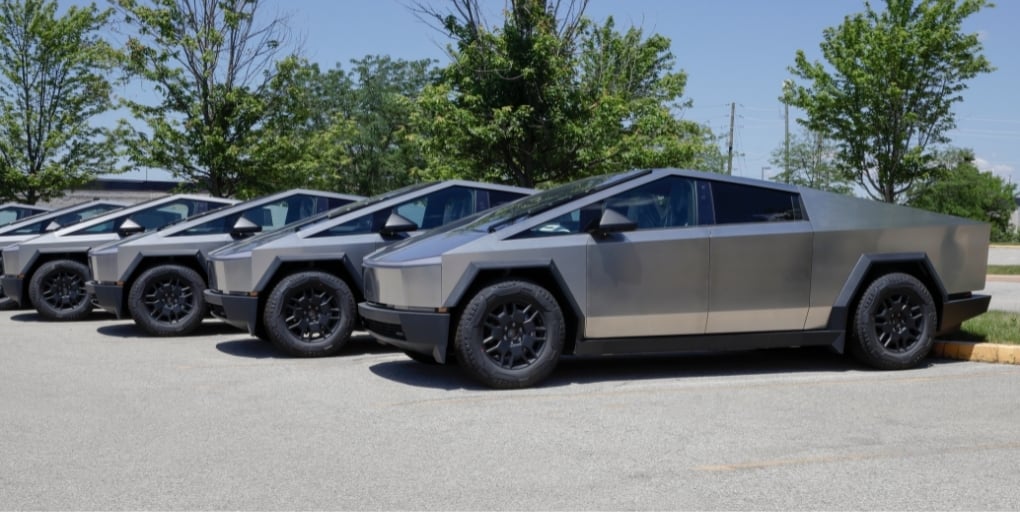

Nearly 70 years after Ford Motor Co. introduced one of the most famous failures in automotive history, Tesla’s Cybertruck may be making a run at the same dubious distinction, according to Bloomberg.
Ford unveiled the Edsel in 1957 with enormous expectations. The automaker predicted it would sell 200,000 units during the car’s first year, but actual sales totaled less than one-third of that target. It’s unusual vertical grille, often compared to a horse collar, quickly became the subject of jokes, and Ford discontinued the Edsel in 1959 after sales declined each year.
Tesla began delivering the Cybertruck in 2023 following years of promotion by CEO Elon Musk, who called it the company’s best product ever. Musk suggested Tesla could eventually build more than 250,000 Cybertrucks annually, depending on demand.
That demand has not materialized.
Tesla sold fewer than one-sixth of that projected annual volume during the truck’s first year, Bloomberg reported. U.S. registrations have continued to slide, totaling just 7,133 through May of this year, according to S&P Global Mobility data provided to Bloomberg News. Even that number received a boost from Musk’s rocket company, SpaceX, which has been assembling its own fleet of Cybertrucks.
Tesla does not separately report Cybertruck sales in its financial statements, making registrations and other industry estimates important indicators of the truck’s performance.
Garrett Nelson, an equity analyst with CFRA Research, told Bloomberg he does not expect Tesla to discontinue the Cybertruck within the next year or two. Tesla could attempt a redesign or introduce a different version to attract more buyers, although Nelson said such an effort would probably be futile. His expectation is that the Cybertruck will simply fade away.
Tesla did not respond to Bloomberg’s request for comment.
Automotive history is filled with vehicles that failed to meet expectations. John DeLorean’s stainless-steel sports car, introduced in the early 1980s, suffered from quality problems and carried a price more than twice that of the average new vehicle. Only about 9,000 were produced.
General Motors introduced the Pontiac Aztek in 2000, only to face immediate criticism over its heavily clad and unconventional exterior styling. According to Edmunds data cited by Bloomberg, the Aztek reached only 37% of its 75,000-unit sales target during its best year. GM discontinued it in 2005.
What separates the Edsel and Cybertruck from many other failures is the enormous gap between the manufacturers’ initial expectations and the number of customers who actually bought them.
Ford supported the Edsel’s introduction with a prime-time television special showcasing features such as its rotating dome speedometer and Teletouch push-button transmission controls mounted in the center of the steering wheel. Its base price was less than $2,500, equal to roughly $30,000 today, as Ford attempted to make it accessible to middle-class buyers.
The timing was poor. The United States entered a recession in 1958, and consumers became more cautious about spending. The Edsel’s styling also failed to appear modern despite Ford’s extensive consumer research.
Automotive journalist and historian Don Sherman told Bloomberg that most people simply considered the car ugly.
The Cybertruck experienced its own memorable introduction in 2019. Tesla demonstrated the strength of its stainless-steel body by striking it with a sledgehammer, which caused no visible dent. The demonstration took an embarrassing turn when chief designer Franz von Holzhausen threw a metal ball at the Cybertruck’s supposedly armored window and shattered the glass.
Customers nevertheless placed thousands of reservations after Tesla announced an expected starting price of $39,900. By the time deliveries finally began several years behind schedule, early versions cost more than $100,000.
Stephanie Valdez Streaty, director of industry insights at Cox Automotive, told Bloomberg the Cybertruck remains a niche vehicle because of its polarizing design and high price.
Both vehicles also struggled with quality and design problems. The Edsel’s Teletouch transmission controls frequently malfunctioned and confused drivers because the buttons were located where they expected to find the horn. Production quality also suffered because Edsels were assembled alongside Ford and Mercury models, requiring workers to repeatedly switch tools without slowing the assembly line. Some cars reportedly arrived at dealerships unfinished, with parts placed in the trunk for dealers to install.
The Cybertruck’s stainless-steel body proved difficult to form and weld. The model has faced multiple recalls, and Tesla has been sued over allegations that its doors could not be opened following a crash.
Musk’s political activities have created another challenge. Bloomberg reported that his support for President Donald Trump, his role leading the Department of Government Efficiency and the resulting cuts to federal programs and workforces led to protests at Tesla stores, boycott campaigns and some owners selling their vehicles. The Cybertruck’s distinctive appearance made it an especially visible symbol of public attitudes toward Musk.
Ford reportedly lost about $350 million on the Edsel, equivalent to approximately $2.5 billion today. Yet the car eventually gained collector appeal, with restored examples selling for as much as $35,000.
Whether the Cybertruck someday enjoys a similar revival remains unknown.
Jessica Caldwell, head of insights at Edmunds, told Bloomberg that the Cybertruck’s unconventional design was always likely to limit it to a niche audience rather than appeal to traditional truck buyers. Instead of simply attracting attention, she said, it has become a highly visible representation of divided public opinion surrounding Tesla and Musk.

.jpg?width=150&name=jerry-headshot.jpg%20(1).jpg)