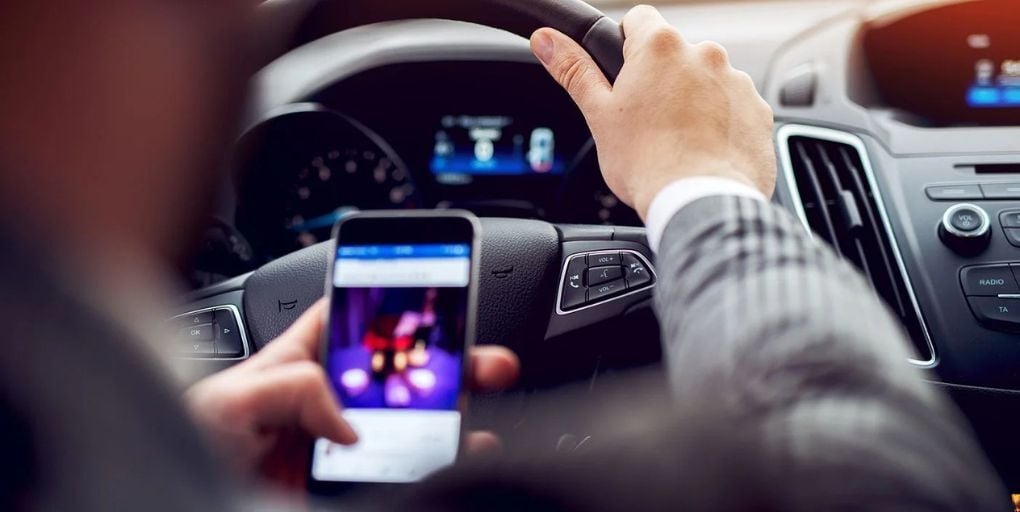

April is National Distracted Driving Awareness Month, a timely reminder that one of the most dangerous habits on America’s roads isn’t speeding or bad weather—it’s the glowing screen in the palm of your hand.
According to the National Highway Traffic Safety Administration, 3,208 people were killed in distracted driving crashes in 2024. That number has remained stubbornly high despite years of public awareness campaigns, tougher state laws, and hands-free technology becoming standard in many new vehicles.
Other stats include:
- 5% of fatal crashes, an estimated 13% of injury crashes, and an estimated 12% of all police-reported traffic crashes were reported as distraction-affected in 2024.
- 6% of drivers 15 to 20 years old involved in fatal crashes were reported as distracted. This age group has the largest proportion of drivers who were distracted at the time of the fatal crashes.
- 639 nonoccupants (pedestrians, pedalcyclists, and others) were killed in distraction-affected traffic crashes in 2024.
Distracted driving falls into three categories: visual (taking your eyes off the road), manual (taking your hands off the wheel), and cognitive (taking your mind off driving). Texting while driving manages to check all three boxes, which is why safety officials continue to single it out as the most dangerous behavior behind the wheel.
The problem is far from limited to texting. Drivers scrolling social media, watching videos, adjusting navigation systems, or even eating lunch on the go all contribute to the issue. Ironically, as vehicles become more technologically advanced, the number of potential distractions inside the cabin has increased. Large infotainment screens, while convenient, can pull attention away from the road longer than drivers realize.
A few years ago, Lexus released a video highlighting the dangers of texting while driving- to disprove the misconception that texting and driving creates only a momentary distraction. The average length of time it actually takes to send or receive a text message when you're behind the wheel is 4.6 seconds. At 55 mph, that's like driving the length of an entire football field with your eyes closed.
In the video called "Driving Disrupted," Lexus demonstrates exactly what happens when drivers can no longer see the road for 4.6 seconds. Participants get behind the wheel of a Lexus NX on a closed course, thinking they're taking the vehicle for a routine test drive. But they're not driving an ordinary NX. They're driving a one-of-a-kind specially modified vehicle called the NX 4.6. It's equipped with electrochromic technology that turns the windshield and windows from transparent to opaque instantaneously, completely obscuring the driver's view for 4.6 seconds. The video captures the chaos that ensues. If you have a young driver in your house OR if you occasionally text and drive, take a couple of minutes and watch!
Watch this incredibly impactful video here:
In a recent survey from AAA Foundation for Traffic Safety, surveyed drivers reported sending a text/email (28%), reading a text/email (37%), or holding and talking on a phone (36%) while driving in the past 30 days, despite the fact that the majority felt those behaviors are extremely or very dangerous.
Law enforcement agencies across the country are stepping up patrols this month, and many states are increasing fines and penalties for violations. Texas, for example, bans texting while driving statewide, with fines that can exceed $200 for repeat offenders. But enforcement alone hasn’t been enough to curb the problem.
Automakers have tried to help by integrating hands-free systems such as Apple CarPlay and Android Auto, along with voice-activated controls. While these features can reduce manual distraction, safety experts warn they don’t eliminate cognitive distraction. In other words, just because your hands are on the wheel doesn’t mean your mind is on the road.
There’s also growing concern about semi-autonomous driving systems. While technologies like adaptive cruise control and lane-keeping assist can reduce driver workload, they can also create a false sense of security. Regulators, including the National Transportation Safety Board, have repeatedly emphasized that these systems are not a substitute for attentive driving.
The bottom line is simple: no technology, law, or awareness campaign can replace personal responsibility. Safety advocates recommend a few straightforward steps to reduce distraction. Put your phone on “Do Not Disturb” mode before driving. Set your navigation and music before you leave. If something demands your attention, pull over safely rather than trying to handle it in motion.
For parents, the stakes are even higher. Young drivers are among the most likely to engage in distracted behaviors, and they often model what they see. Setting a good example behind the wheel may be one of the most effective safety tools available.
Distracted driving doesn’t always end in tragedy, but when it does, it’s almost always preventable. During National Distracted Driving Awareness Month, the message from safety officials is clear: whatever it is, it can wait.
Photo Credit: Dusan Petkovic/Shutterstock.com.